

Accredited Online Interior Design Classes: Certificates, Degrees, and Professional Programs
Table of Contents
Accredited online interior design classes – The job posting for “Senior Interior Designer” at the architectural firm was perfect, listing requirements I felt confident I could meet—until I hit the third bullet point: “Must have a degree from a CIDA-accredited program and be NCIDQ eligible”. I stared at the screen, realizing my portfolio of self-taught projects and unaccredited online certificates might not be enough for the professional league I wanted to enter. This is the critical juncture many aspiring designers face: the realization that while anyone can call themselves a “decorator,” becoming a licensed or registered “interior designer” often requires specific, accredited education. I dove into researching accredited online interior design classes, discovering a complex landscape where “accreditation” means different things to different schools. There were fully accredited bachelor’s degrees from institutions like Yorkville University and Rocky Mountain College of Art + Design that opened doors to licensure. There were professional certificate programs from Jackson College recognized by industry bodies like the Designer Society of America (DSA) but not CIDA. And there were countless “certified” courses that held no weight with employers. Choosing accredited online interior design classes isn’t just about learning to pick colors; it’s about investing in a credential that legally and professionally qualifies you for the career you want—whether that’s residential decoration or commercial architectural design.
Navigating accreditation standards is the single most important step for career-focused students. The Council for Interior Design Accreditation (CIDA) is the gold standard in North America, validating that a program meets the rigorous educational requirements for professional practice and NCIDQ exam eligibility. Very few fully online programs achieve this status due to the hands-on nature of studio work, but exceptions like Yorkville University (Canada) and hybrid options exist. For those focused on residential design or starting their own businesses without needing commercial licensure, institutional accreditation or specialized industry recognitions (like DSA or RIDQC) found in programs at Jackson College or NYIAD offer valid, respectable pathways at a lower cost and shorter timeline. Distinguishing between these paths—CIDA-accredited degrees for commercial careers vs. professional certificates for residential entrepreneurship—prevents costly educational missteps.
This detailed guide explores the world of accredited online interior design education, clarifying the difference between CIDA accreditation and other credentials, comparing comprehensive degree programs from universities like Rocky Mountain College of Art + Design and Yorkville University, analyzing professional certificate programs from institutions like Jackson Community College that prepare for residential certification, and providing the curriculum insights needed to choose the right interior design principles class online for your professional goals. Whether you aim to design skyscrapers’ interiors or launch a boutique residential firm, this guide maps the accredited routes to get you there.
The Hierarchy of Accreditation: What Matters and Why
“Accredited” is a broad term. In interior design, specific types of accreditation determine your career ceiling.
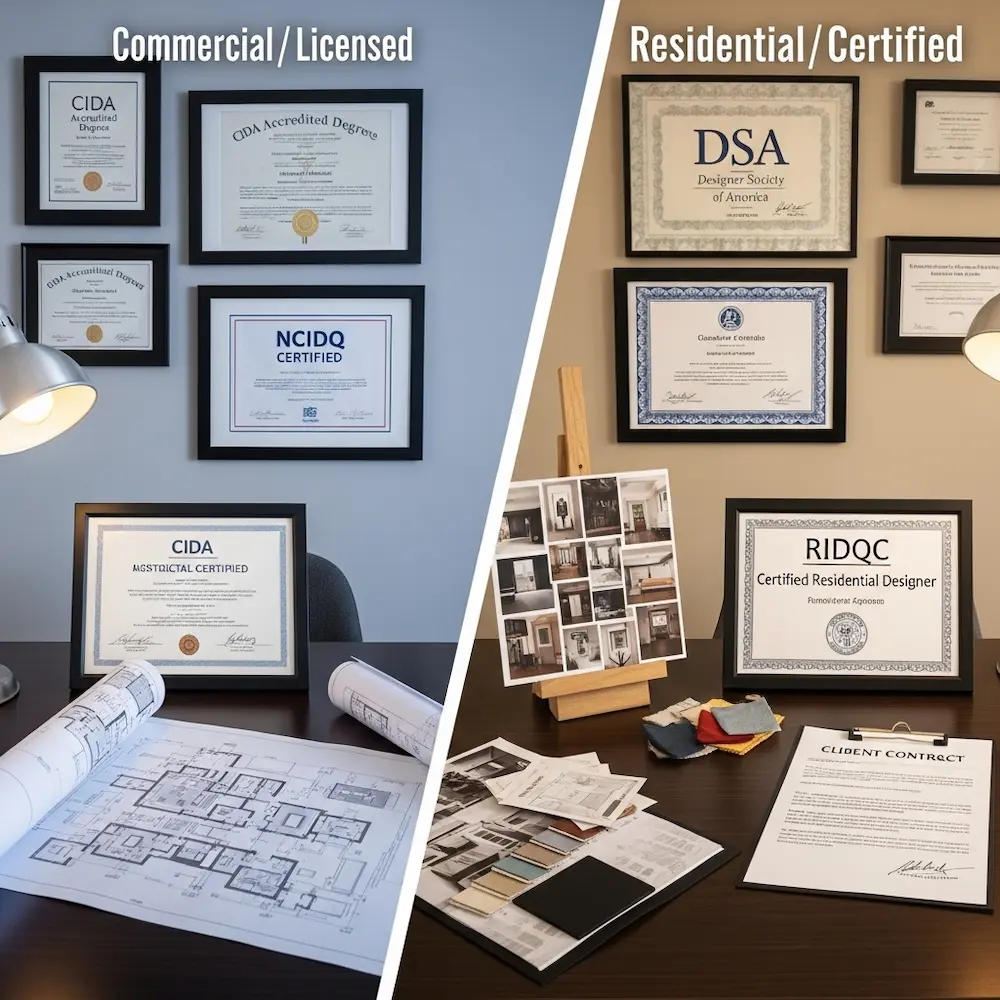
CIDA: The Professional Gold Standard
What it is: The Council for Interior Design Accreditation (CIDA) evaluates and accredits interior design education programs at colleges and universities. It ensures the curriculum covers critical technical areas like building codes, lighting, construction documents, and contract administration—not just aesthetics.
Why it matters:
- Licensure: In many U.S. states and Canadian provinces, you cannot call yourself a “Registered Interior Designer” without passing the NCIDQ exam.
- NCIDQ Exam: To sit for this exam, you typically need a degree from a CIDA-accredited program (or a non-accredited degree plus significantly more work experience).
- Commercial Work: Large architectural firms and commercial projects (hospitals, hotels, government buildings) almost exclusively hire graduates from CIDA-accredited programs because liability and code compliance are paramount.
Online Availability: CIDA accreditation for fully online programs is rare.
- Yorkville University: Explicitly markets itself as “the only CIDA-accredited online degree in Canada without a residency requirement”.
- Rocky Mountain College of Art + Design (RMCAD): Offers a CIDA-accredited BFA in Interior Design available online.
- Academy of Art University: Its online BFA is CIDA-accredited, mirroring its on-campus curriculum.
Industry Certifications (DSA, RIDQC)
What they are: For designers focusing on residential projects where strict commercial codes are less dominant, industry bodies like the Designer Society of America (DSA) offer certification pathways.
Example: The Jackson College “Certified Residential Interior Designer” program prepares students for the RIDQC (Residential Interior Design Qualifying Certification) exam.
Why they matter: These credentials signal professional competence to residential clients and validate your skills in starting a business, without requiring a 4-year degree. They are perfect for career changers entering residential design.
Top CIDA-Accredited Online Degree Programs
For those committed to a full professional career including commercial design and licensure, these bachelor’s programs are the top tier.
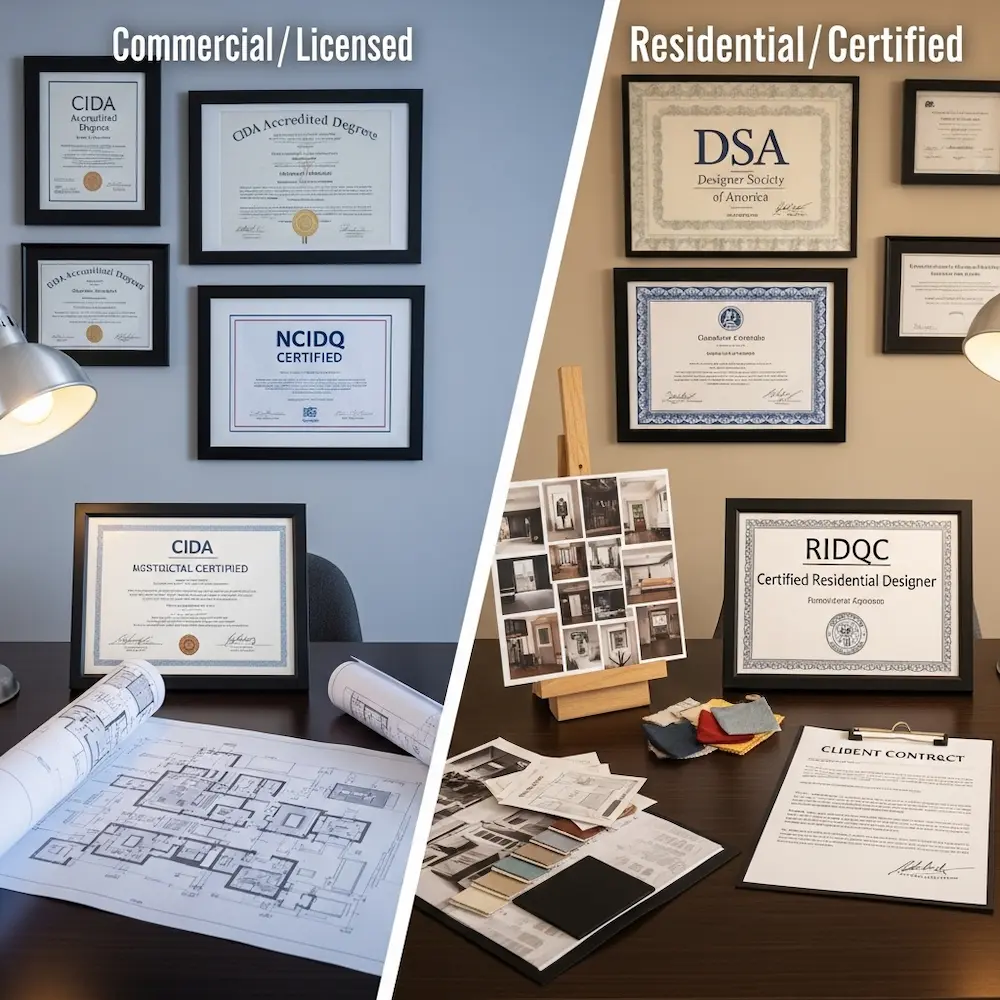
Rocky Mountain College of Art + Design (RMCAD)
Program: Bachelor of Fine Arts (BFA) in Interior Design.
Accreditation: CIDA-accredited.
Curriculum Focus: RMCAD’s program is technically rigorous. It moves far beyond decoration into architectural understanding.
- Key Courses: “Introduction to Sustainable Design” (ID 1230), “Building Codes + Regulations” (ID 2530), “Building Information Modeling: Revit” (ID 3715).
- Software: Heavy emphasis on CAD, Revit, and rendering—essential for employability in firms.
Format: Online students work closely with faculty who are practicing professionals. The curriculum is identical to the on-campus version.
Yorkville University (Canada)
Program: Bachelor of Interior Design.
Accreditation: CIDA-accredited (and recognized by ARIDO/IDC in Canada).
Unique Advantage: It is designed specifically for online delivery without a residency requirement, making it accessible to students anywhere.
Focus: “Sustainable design solutions for the health, welfare and safety of individuals”. This emphasizes the technical and ethical responsibilities of a professional designer.
Academy of Art University
Program: BFA in Interior Architecture & Design.
Accreditation: CIDA-accredited.
Strength: Known for its practical, portfolio-driven approach. Students graduate with professional-level portfolios that demonstrate skills in commercial, hospitality, and residential design.
Professional Certificate Programs: The Flexible Alternative
Not everyone needs a 4-year degree. If your goal is residential design or specialized skills, accredited certificate programs offer a faster, more affordable route.
Jackson College (Online Residential Interior Design)
Program: Certified Residential Interior Designer.
Credential: Prepares for the R.I.D.E. (Residential Interior Design Education) credential and RIDQC exam.
Affiliation: Designer Society of America (DSA).
Curriculum:
- Focuses on the business of residential design: running a business, client management, and residential specific design principles.
- Bonus: Includes a free one-year DSA membership and the RIDQC exam voucher.
Best For: Career changers who want to launch a residential design business quickly and legitimately.
New York Institute of Art and Design (NYIAD)
Program: Interior Design Professional Certificate.
Accreditation/Recognition: Certified by the Designer Society of America (DSA).
Structure: Self-paced, up to 24 months to complete.
Cost: Affordable (~$1,000 – $1,500 range often with discounts), significantly less than a degree.
Curriculum: Covers design trends, history, furniture styles, lighting, and color, plus business basics.
Value: Excellent for “decorators” wanting to upgrade to “designers” in the residential space without the intense technical load of CIDA programs.
Core Curriculum: What Accredited Classes Teach
Whether degree or certificate, accredited programs share a commitment to structured, comprehensive learning that hobbyist courses lack.
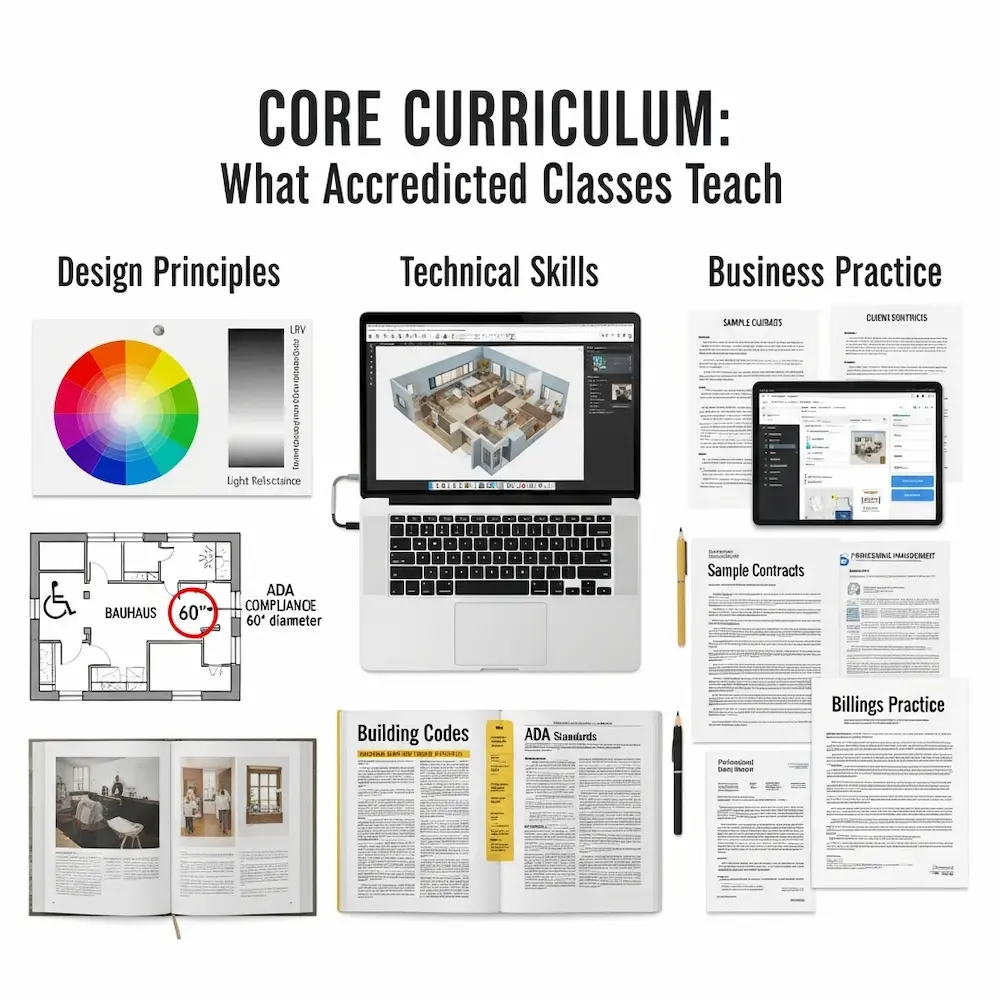
Interior Design Principles Class Online
Every accredited program starts here. But unlike a YouTube video on “picking colors,” an accredited interior design principles class online covers the science of design.
- Space Planning: Not just where the sofa goes, but traffic flow, ergonomics, and accessibility (ADA compliance).
- Color Theory: Beyond aesthetics—psychological impacts, light reflectance values (LRV), and pigment mixing.
- History of Architecture & Furniture: Identifying styles from Baroque to Bauhaus is essential for professional credibility.
Technical & Business Skills
This is where accredited programs truly separate themselves.
- Building Codes: Understanding safety regulations, egress requirements, and materials standards is what makes interior design a licensed profession. RMCAD’s “Building Codes + Regulations” is a prime example.
- Professional Practices: Contracts, project management, billing structures, and liability. Jackson College’s program explicitly focuses on “tools you need to successfully run your own interior design business”.
- Software: As detailed in our cluster on online AutoCAD classes, accredited programs mandate proficiency in tools like Revit and CAD.
Choosing the Right Accredited Path
Choose a CIDA-Accredited Degree (RMCAD, Yorkville, Academy of Art) If:
- You want to work on commercial projects (hotels, hospitals, offices).
- You plan to take the NCIDQ exam and become a “Registered/Licensed Interior Designer”.
- You want to work for major architectural or design firms.
- You can invest 3-4 years and higher tuition for a lifelong professional credential.
Choose a Professional Certificate (Jackson College, NYIAD) If:
- You want to focus on residential design (kitchens, baths, home decor).
- You plan to start your own business and work directly with homeowners.
- You are a career changer needing a faster, more affordable entry point (6-18 months).
- You want a recognized credential (RIDQC) to build trust with clients but don’t need commercial licensure.
Conclusion
The choice between accredited online interior design classes determines the ceiling of your career. If your dream is to design the lobby of a skyscraper or a cutting-edge hospital, a CIDA-accredited degree from Yorkville University or RMCAD is your non-negotiable path, providing the rigorous technical and code-based education required for licensure. However, if your passion lies in transforming homes and running your own studio, a professional certificate from Jackson College or NYIAD offers a recognized, practical, and efficient route to becoming a certified residential designer. Neither path is “better”—they simply lead to different destinations. By choosing the program that aligns with your specific career goals—commercial licensure vs. residential entrepreneurship—you invest your time and money in a credential that truly serves your future.
For a broader look at all your options, return to our ultimate guide to interior design classes online. If cost is a major factor, explore our guide to interior design classes online free. And regardless of your path, mastering technical tools is essential—check out our guide to online AutoCAD classes for interior design to start building your technical toolkit.


