

Interior Design Classes Online Free: Best Beginner Courses and Program Costs
Table of Contents
Interior design classes online free – I clicked “Enroll Now” on the $8,000 interior design certificate program, my cursor hovering over the payment button. Eight thousand dollars felt impossibly steep for someone who wasn’t even sure if interior design was more than a Pinterest obsession. “Start with free courses first,” my budget-conscious friend advised, “see if you actually enjoy the process before spending a fortune”. That simple suggestion changed my approach entirely. Within an hour, I’d discovered Coursera courses I could audit for free, YouTube playlists offering structured curricula, and Udemy classes with occasional $0 promotions. Over the next three months, I completed five free interior design classes online, learning color theory fundamentals, basic space planning, and furniture arrangement principles without spending a cent. More importantly, I confirmed that design genuinely captivated me—enough to justify investing in a paid certificate program. But even after enrolling, those free courses continued serving as supplementary resources for topics my paid program glossed over. Free interior design classes online serve dual purposes: risk-free exploration for beginners uncertain about design passion, and cost-effective skill supplementation for students in paid programs seeking additional perspectives or deeper dives into specific topics.
Understanding the landscape of interior design classes online free requires recognizing that “free” exists on a spectrum. Some platforms like Coursera and edX offer fully free course access through “auditing,” allowing you to watch videos and read materials without paying, though certificates cost extra. Others like Udemy periodically promote specific courses at $0, though the same course might cost $50 next week. YouTube channels provide completely free structured playlists, but quality and comprehensiveness vary wildly. And community colleges occasionally offer free introductory workshops, though sustained programs require tuition. Simultaneously, understanding interior design class online cost for paid programs—ranging from $45 for basic online courses to $10,000+ for university certificates—clarifies when free options suffice versus when investment becomes necessary. This guide explores both dimensions: maximizing free resources for foundational learning and cost-effective exploration, then evaluating when and where to invest in online interior design classes certificates that provide recognized credentials.
This comprehensive analysis covers free interior design education platforms including Coursera and edX MOOCs with audit options, Udemy promotional courses and limited-time free offerings, YouTube structured playlists and tutorial series, cost breakdowns for paid programs from budget online courses ($45-$500) through mid-tier certificates ($1,000-$3,000) to premium university programs ($5,000-$10,000+), strategies for combining free resources with selective paid investments, and guidance on when free courses suffice versus when recognized credentials justify costs. Whether you’re testing design interest with zero financial risk or strategically building skills on a tight budget, this guide provides the roadmap for navigating free and affordable interior design education.
Top Platforms for Free Interior Design Education
Multiple platforms provide legitimate, quality free interior design instruction.
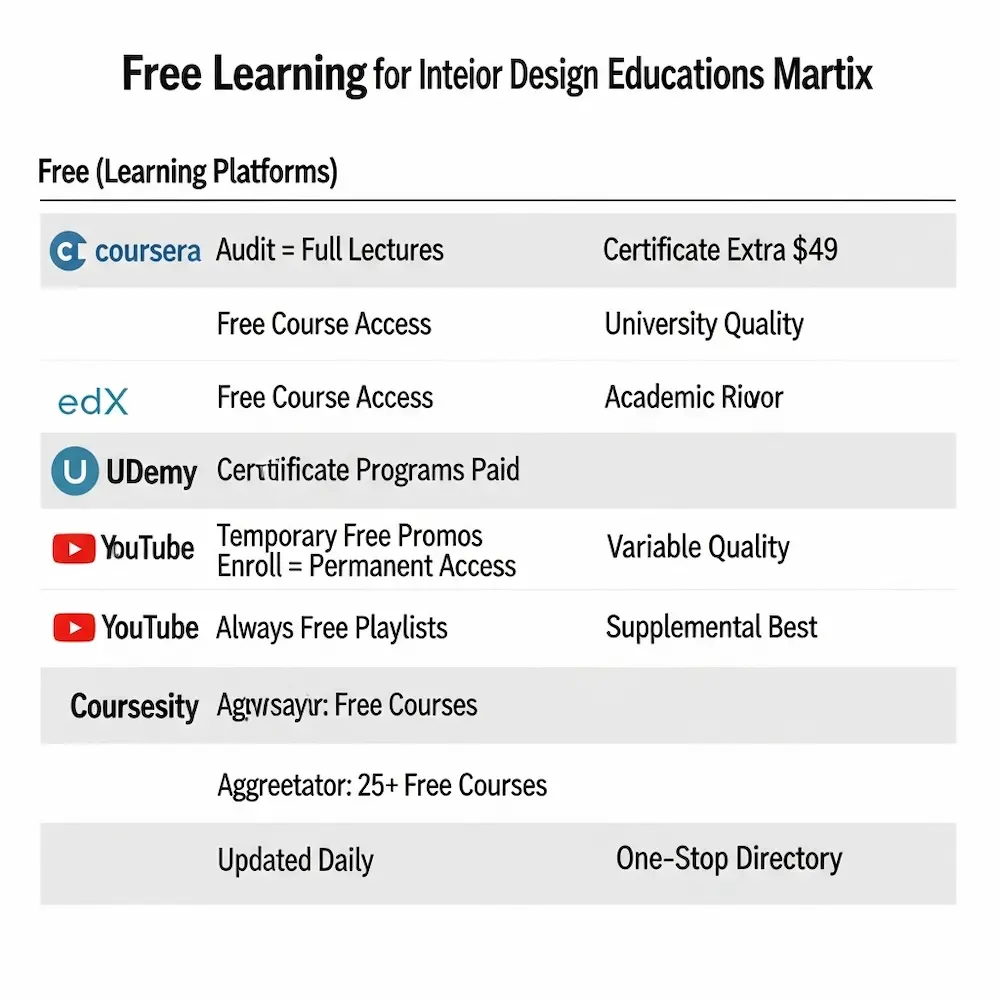
Coursera: Audit for Free, Pay for Certificates
How it works: Coursera explains, “You can start learning interior design on Coursera for free in two ways”. The platform offers full course access through “auditing” where you watch lectures and access readings without paying. However, “If you want to keep learning, earn a certificate in interior design, or unlock full course access after the preview or trial, you can upgrade or apply for financial aid”.
What you’ll learn: Coursera’s interior design courses “can help you learn space planning, color theory, furniture arrangement, and lighting design”. Courses “explore design history, sustainability, and tools like SketchUp, CAD or other digital rendering software”. The “Blueprint to Brilliance Through Interior Design course offers insights into creating impactful designs”.
Best for: Beginners seeking structured, university-level instruction without cost. The auditing model works perfectly for exploration—you get the educational content without the credential.
Limitations: Auditing typically excludes graded assignments, peer feedback, and certificates. You learn but can’t prove completion to employers.
edX: University Courses with Free Access Options
Platform overview: edX partners with universities to deliver online courses. Their “Introduction to Interior Design Professional Certificate” from LCI Education “is designed to provide learners with the foundational knowledge to start a rewarding career in Interior Design”.
Free vs. paid: Like Coursera, edX offers free audit tracks for many courses. The professional certificate programs cost money, but individual course components may be auditable. Check specific course pages for “Audit This Course” options.
Course quality: University-backed courses provide academic rigor often missing from hobbyist content. edX’s interior design offerings cover both creative and technical foundations.
Udemy: Periodic Free Promotions
The Udemy model: Udemy hosts thousands of instructor-created courses that typically cost $15-$70. However, instructors can promote courses for free temporarily, and Coursesity tracks “Interior Design – Free udemy Courses”.
Free course examples from Coursesity’s compilation:
- “How to Design a Room in 10 Easy Steps: Interior Design Made Simple” (2 hours)
- “Design is in the Details: How to Accessorize Like a Pro” (2 hours 5 minutes)
- “Interior ArchViz: Create Surreal 3D Designs with Blender” (2 hours 32 minutes)
The catch: Free promotions are temporary. A course free today might cost $50 tomorrow. Coursesity and similar aggregators help track current free offerings, but requires checking regularly.
Strategy: Enroll in free Udemy courses when available even if you can’t start immediately—enrollment locks in free access permanently.
YouTube: Completely Free, Variable Quality
Structured playlists: Some creators offer comprehensive free courses. The video “A Free interior design course for beginners from A to Z” promises to teach “everything about interior design… how to organize furniture, how to choose the room material, how to choose colours for a room”. The creator claims “at the end of this course you will be a professional in interior design”.
Reality check: YouTube’s “professional” claims should be taken with skepticism. Free YouTube content excels at introducing concepts and demonstrating techniques but rarely provides the structured, comprehensive education paid programs deliver.
Best use: YouTube supplements paid courses beautifully. Struggling with a specific concept like lighting placement? YouTube has dozens of explanations from different perspectives. Need inspiration for color palettes? Endless examples exist.
Coursesity’s Comprehensive Free Course Directory
The aggregator: Coursesity compiles “25+ Free Interior Design Courses & Tutorials Online” from “MOOCs and online education providers such as Udemy, Coursera, Edx, Skillshare, Udacity, Bitdegree, Eduonix, QuickStart, YouTube and more”.
- “Interior Design Tutorial – Mastering Interior design styles” (1 hour 5 minutes)
- “Interior Design Tutorial – Interior Design Process of a Cafe/Restaurant”
- “Interior Design Tutorial – Materials and Finishes in Interior Design”
Updating: The site notes, “The interior design courses list are updated at regular interval to maintain latest status”, helping you find currently available free options.
Certificate note: “Some courses provide free certificate on course completion”, though these free certificates carry minimal professional weight.
Understanding Interior Design Class Online Cost
When free resources prove insufficient, understanding paid program costs helps budget appropriately.
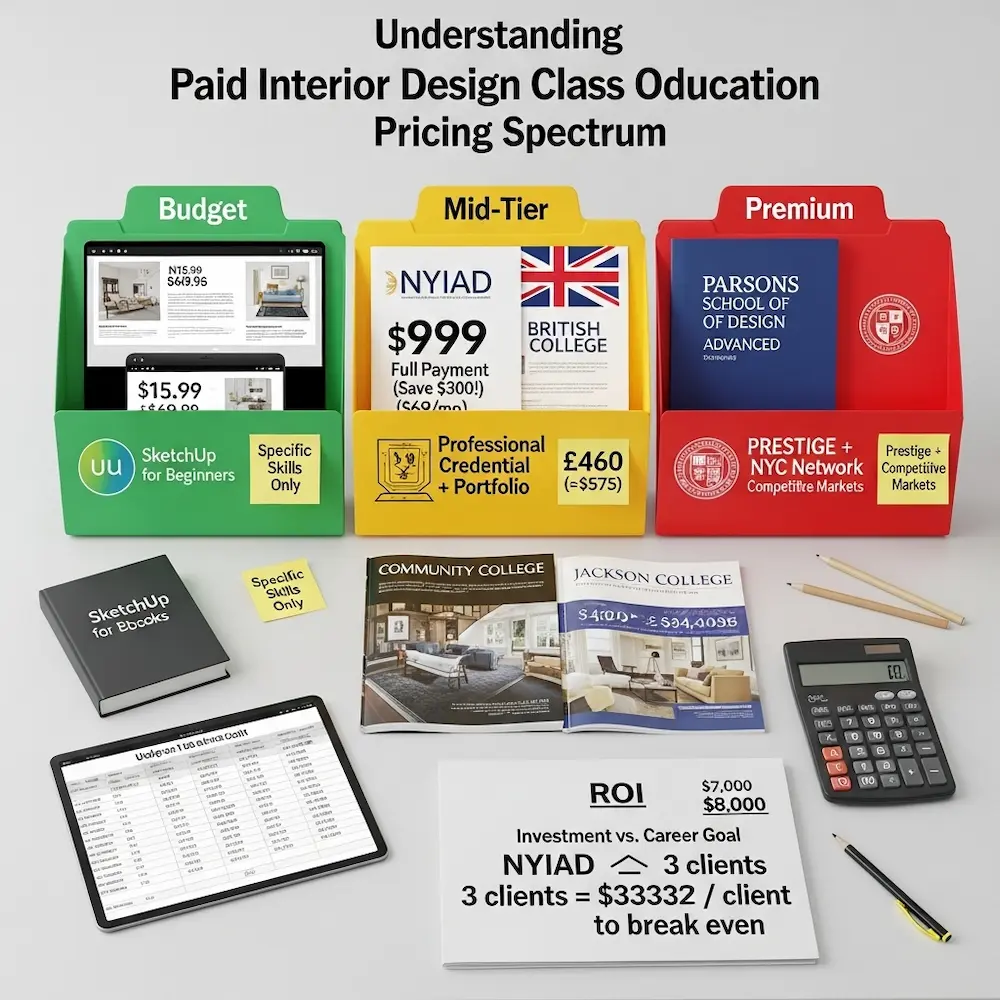
Budget Online Courses ($15-$500)
Individual Udemy courses: AND Academy’s review notes, “You can expect to pay anywhere from $15.99 to $69.99 for individual courses”. These standalone classes teach specific skills—a Udemy course on SketchUp, a $30 class on color theory—without comprehensive curricula.
Online school courses: Coursesoo reports “Online Schools cost: $45 – $2,500+ USD”. These might be single courses from institutions not offering full programs.
Value proposition: Budget courses suit supplementing free learning with specific skills. Need to learn 3D rendering? A $50 Udemy course on Blender for interior visualization might suffice without enrolling in a full program.
Mid-Tier Certificate Programs ($1,000-$3,000)
New York Institute of Art & Design (NYIAD): Upskillist details NYIAD’s pricing:
- Full Payment Plan: $999 (originally $1,299—save $300) with “immediate access to all materials”
- Monthly Payment Plan: $1,299 total, starting with “$59 upfront, then $69/month”
- Optional extras: “Physical course materials for $250 and a $60 RIDQC Certification Exam Proctor Fee”
The Interior Design Institute: AND Academy reports approximately “$189 for certificate programs”, though this seems to reference monthly costs rather than total program price based on context.
Community college continuing education: Coursesoo lists “Community College or Continue Education Centres cost: $300 – $4,000+ USD”. Jackson College’s residential designer program falls in this category.
British College of Interior Design: Costs “approximately $575 (converted from £460), with a lower pricing option of around $500 (approximately £400)”. “Flexible payment plans, including a discounted full payment or a two-installment option”.
Value assessment: Mid-tier certificates ($1,000-$3,000) provide recognized credentials, structured curricula, and instructor feedback that free courses lack. For career changers or aspiring residential designers, this investment typically recovers within first few client projects.
Premium University Certificates ($5,000-$10,000+)
Parsons School of Design: Upskillist notes Parsons’ certificate program costs “$5,000” for the basic Certificate in Interior Design. The Advanced Certificate costs “$8,000”. “Flexible payment options are available to make enrollment more accessible”.
University continuing education: Coursesoo reports “College or University cost: $600 – $10,000+ USD”. This range reflects both short courses and comprehensive certificate programs.
What you’re paying for: Premium pricing reflects institutional prestige, faculty credentials, and networking opportunities. Parsons graduates enter design networks and industries difficult to access from lesser-known programs.
ROI consideration: $8,000 for Parsons’ Advanced Certificate makes sense if targeting competitive urban design markets (NYC, LA, SF) where institutional reputation opens doors. For residential design in smaller markets, mid-tier certificates provide adequate credentials at fraction of cost.
Hidden Costs in “Free” Courses
Understanding what free courses don’t include clarifies their limitations.

Certificates Require Payment
The credential upcharge: Coursera states clearly that while you can audit for free, “If you want to… earn a certificate in interior design, or unlock full course access after the preview or trial, you can upgrade”. Certificate fees typically range $49-$99 per course.
Professional value: Free Coursera/edX certificates hold minimal professional weight. Employers recognize CIDA-accredited degrees or industry certifications (NCIDQ, RIDQC) but rarely value MOOC certificates. Use free courses for learning, not credentials.
No Personalized Feedback
Automated vs. human interaction: Free courses offer video lectures and quizzes but rarely include instructor feedback on your design work. Learning theory differs from applying it—you might understand color theory principles but need expert critique to recognize when your palette fails.
Peer review limitations: Some MOOCs use peer grading, where students review each other’s work. This provides feedback but lacks professional expertise. An instructor knowing code requirements, client expectations, and industry standards offers insights peers can’t match.
Limited or No Portfolio Development
Project-based learning gaps: Free courses might include assignments, but without instructor guidance, portfolio quality suffers. Certificate programs structure projects specifically for portfolio building, ensuring graduates have professional-quality work samples.
Career impact: Portfolios determine hiring far more than certificates. Free courses teach skills; paid programs build portfolios proving those skills to employers.
Strategic Approach: Combining Free and Paid Resources
Maximize value by using free resources strategically, investing selectively in paid programs.
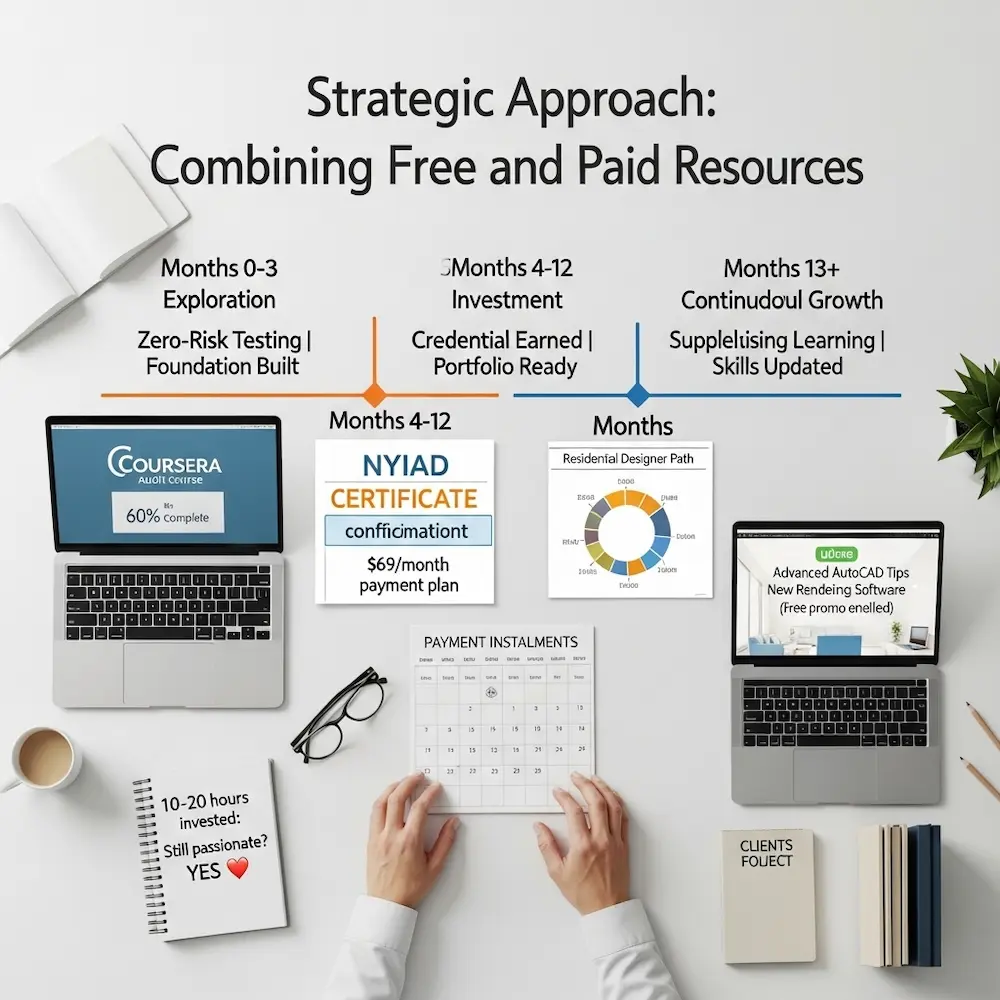
Start Free for Exploration
Zero-risk testing: Begin with free Coursera/edX courses or YouTube playlists. If design captivates you after 10-20 hours of free learning, passion justifies investing in paid programs. If free courses bore you or feel forced, you’ve saved thousands discovering design isn’t your calling.
Foundation building: Free courses teach terminology, basic concepts, and design history. This foundation makes paid program content more accessible—you’re not simultaneously learning vocabulary and applying principles.
Invest in Credentials When Ready
Career pathway alignment: As discussed in our guide to accredited online interior design classes, choose paid programs based on career goals. Residential designers might invest $1,000-$3,000 in mid-tier certificates (NYIAD, Jackson College). Those pursuing commercial design or licensure need CIDA-accredited degrees despite higher costs.
Payment plans ease burden: Most certificate programs offer monthly payments. NYIAD’s “$69/month” option makes $1,300 total cost manageable for working professionals.
Supplement Paid Programs with Free Resources
Skill gaps: Paid programs can’t cover everything comprehensively. If your certificate program’s AutoCAD instruction feels rushed, free YouTube tutorials or Udemy courses on AutoCAD for interior design supplement nicely. Our guide to online AutoCAD classes for interior design explores specialized software training.
Continuing education: After completing paid programs, free resources enable ongoing skill development. New rendering software? Free tutorials teach basics before you invest in advanced courses.
When Free Courses Suffice vs. When Investment Is Necessary
Free courses work for:
- Personal home redesign projects where professional credentials don’t matter
- Exploring design interest before career commitments
- Supplementing paid education with additional perspectives
- Learning specific software skills like SketchUp basics
Paid programs become necessary for:
- Building professional portfolios that attract clients/employers
- Earning credentials (RIDQC, NCIDQ eligibility) that enable charging professional rates
- Receiving expert feedback improving design quality
- Accessing job placement assistance and industry networks
- Pursuing licensure as registered/certified interior designers
Conclusion
Interior design classes online free provide legitimate pathways for skill development and career exploration without financial risk. From Coursera’s university-backed courses you can audit at no cost through Udemy’s periodically free promotions to YouTube’s vast tutorial libraries, free resources teach foundational concepts, introduce design thinking, and help you determine whether interior design genuinely captivates you enough to justify financial investment. However, understanding interior design class online cost—ranging from $45 for individual Udemy courses through $1,000-$3,000 for professional certificates like NYIAD or Jackson College to $5,000-$10,000 for premium university programs—clarifies when free resources reach their limits and strategic investment in online interior design classes certificates becomes necessary for professional credibility and career advancement.
My journey began with free Coursera courses confirming design passion, progressed to a $1,000 certificate program providing credentials and portfolio pieces, and continues with free YouTube tutorials supplementing ongoing skill development. This blended approach maximized learning while minimizing costs—I didn’t waste thousands on education before confirming interest, but I invested appropriately when career goals demanded recognized credentials. For comprehensive context on all interior design education options, return to our ultimate guide to interior design classes online. To understand which credentials matter for professional practice, explore our guide to accredited online interior design classes. And regardless of free or paid paths, technical skills prove essential—check our guide to online AutoCAD classes for interior design to start building software proficiency.


