

Famous Art Deco Designers and Architects
Table of Contents
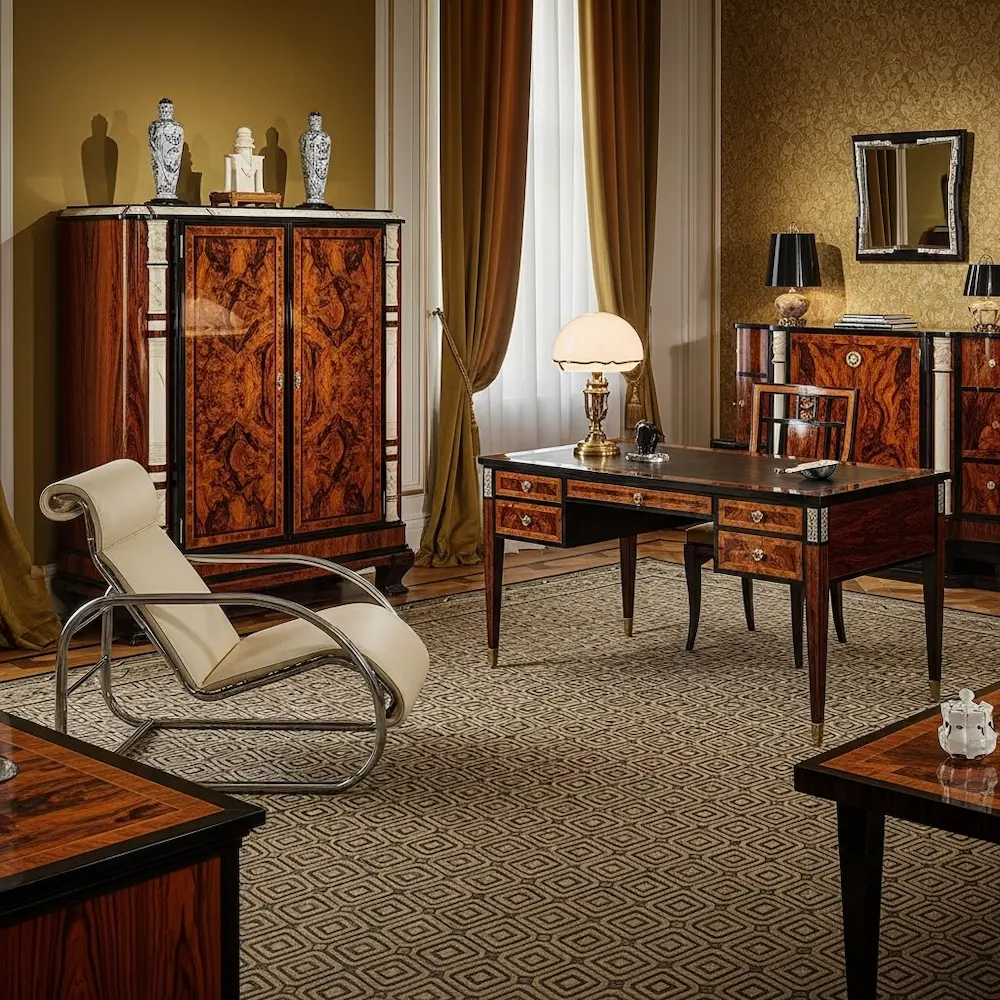
Standing in the lobby of the Chrysler Building, I ran my hand along the red Moroccan marble wall, tracing the geometric inlay patterns that had been specified by William Van Alen nearly a century ago. Above me, the elevator doors—each a masterpiece of marquetry depicting different woods in stylized floral and geometric patterns—gleamed under art deco light fixtures that seemed to capture and multiply the afternoon sun filtering through the building’s famous triangular windows. Every surface, every detail, every material choice reflected a singular artistic vision executed with obsessive precision. Van Alen had died relatively obscure and impoverished, his greatest achievement overshadowed by disputes and Depression-era economics. Yet here his work stood, a daily monument visited by thousands who might never know his name but who absorbed his aesthetic genius simply by moving through the spaces he designed. This poignant reality defines many famous art deco designers—brilliant creators whose work defined an era yet whose names remain known primarily to specialists, overshadowed by the very buildings, furniture, jewelry, and graphics that made art deco unforgettable.
Art deco designers represent a remarkable convergence of artistic vision and technical mastery across architecture, furniture design, interior decoration, jewelry, graphic arts, and fashion during the interwar period. These creative pioneers didn’t merely follow aesthetic trends—they invented them, synthesizing influences from ancient cultures, modern technology, fine art movements like Cubism and Futurism, and craft traditions into the coherent visual language we recognize as art deco. From architects like Van Alen who reshaped skylines to furniture masters like Émile-Jacques Ruhlmann who redefined luxury interiors, from jewelry innovators like Cartier’s Jeanne Toussaint who made geometric gemstone settings icons of sophistication to graphic designers like Cassandre who elevated commercial art to gallery-worthy status, these designers collectively created art deco’s visual vocabulary while competing, collaborating, and constantly pushing creative boundaries.
This comprehensive guide explores the famous art deco designers and architects who defined the movement, covering architectural masters who created art deco’s most iconic buildings, furniture and interior designers who brought art deco into homes, jewelry designers who translated geometric precision into wearable art, graphic designers and visual artists who shaped art deco’s commercial face, fashion designers who dressed the era, and the collaborative networks and rivalries that drove art deco’s evolution. Understanding these creative individuals—their biographies, signature styles, major works, and lasting influence—illuminates how art deco emerged not as anonymous style but as the product of specific talented individuals working at the peak of their creative powers during a unique historical moment.
Architectural Masters: Building Art Deco’s Icons
Art deco architecture created some of the 20th century’s most recognizable buildings, and specific architects designed these landmarks. Understanding these architectural masters reveals how individual vision shaped art deco’s built legacy.
William Van Alen: The Chrysler Building Architect
William Van Alen (1883-1954) earned immortality through a single building—though his career encompassed far more. As Novatr’s comprehensive guide explains, “William Van Alen was an American art deco architect who played a significant role in the Art Deco movement. He is best known for designing the iconic Chrysler Building in New York City, which is widely regarded as one of the most important Art Deco buildings in the world”.
The Chrysler Building (1928-1930) represents art deco architecture’s apex. Van Alen’s design featured the famous stainless steel crown with triangular windows suggesting automotive styling (honoring the building’s commissioner, Walter Chrysler), elaborate metalwork including eagle gargoyles at the 61st floor, luxurious lobby materials including red Moroccan marble and exotic wood elevator doors, and innovative structural techniques allowing the crown’s dramatic setbacks. The building’s silhouette became synonymous with New York City itself and established the template for art deco skyscraper design worldwide.
Van Alen’s career tragically declined after his masterpiece’s completion. Disputes with Chrysler over fees damaged his reputation, the Depression eliminated commissions for luxury buildings, and he died in 1954 having designed little else of significance after 1930. Yet his single monument ensures his position among famous art deco designers.
Raymond Hood: Rockefeller Center’s Architect
Raymond Hood (1881-1934) created art deco’s largest coordinated urban project—Rockefeller Center in New York City. As one of the principal architects of this multi-building complex (1930-1939), Hood designed structures that demonstrated art deco’s adaptability to comprehensive urban planning rather than isolated monuments.
Hood’s American Radiator Building (1924) in New York pioneered the use of black brick with gold terra cotta trim, creating dramatic nighttime presence. The Daily News Building (1929-1930) featured vertical emphasis through continuous pilasters and the famous lobby globe. At Rockefeller Center, Hood’s 30 Rockefeller Plaza (originally RCA Building, now Comcast Building) became the complex’s centerpiece, its simple massing and vertical emphasis providing elegant backdrop for the Center’s art deco sculptural program.
Hood died young at 53, but his impact on American art deco architecture extended far beyond his own buildings through his influence on the next generation of designers.
Timothy Pflueger: San Francisco’s Art Deco Master
Timothy Pflueger (1892-1946) defined San Francisco’s art deco character through buildings that remain the city’s most beloved landmarks. Novatr describes him as “a pioneering American architect known for his influential contributions to Art Deco architecture, particularly in San Francisco during the early to mid-20th century”.
Pflueger’s Castro Theatre (1922) brought Mediterranean Revival and early art deco elements to San Francisco’s entertainment architecture. The Pacific Telephone & Telegraph Building (1925) showcased early art deco commercial design. His 450 Sutter Street (1929) featured elaborate Mayan-inspired art deco detailing that made it San Francisco’s most ornate art deco building. The Paramount Theatre in Oakland (1931) created one of America’s most spectacular art deco theater interiors.
Pflueger’s work demonstrated how art deco could incorporate regional influences—his use of California’s light and integration of Asian and pre-Columbian motifs created distinctly West Coast art deco different from New York’s steel-and-chrome aesthetic.
Robert Mallet-Stevens: French Art Deco Innovator
Robert Mallet-Stevens (1886-1945) represented art deco’s sophisticated European manifestation, particularly its intersection with modernism. Novatr notes he was “a prominent French architect and designer known for his significant contributions to the Art Deco movement”.
Mallet-Stevens’ work featured clean lines and geometric forms, flat roofs and cubic volumes, innovative use of concrete, steel, and glass, and emphasis on functionality combined with artistic expression. The Villa Noailles in Hyères, France (1923) exemplified his signature style with asymmetrical composition and attention to spatial relationships. The Rue Mallet-Stevens in Paris showcased his urban design vision with a street of coordinated art deco buildings.
Beyond architecture, Mallet-Stevens designed furniture and interiors applying the same principles of elegance and practicality, and worked in film design creating sets for avant-garde French cinema. His influence extended across disciplines, making him one of the most important famous art deco designers in France.
Other Notable Art Deco Architects
Additional architects shaped art deco’s global spread. Wirt C. Rowland designed the Guardian Building in Detroit (1929) with colorful terra cotta and Native American motifs. Joseph Younger created the Kennedy-Warren Apartment Building in Washington DC with Aztec-influenced facades. Stiles O. Clements designed Los Angeles’s Richfield Tower (1929, tragically demolished 1969) with black terra cotta and gold detailing. Henry Hohauser created Miami Beach’s Colony Hotel (1935) and numerous other South Beach art deco buildings that made Miami a preservation showcase.
Furniture and Interior Design Masters
Art deco interior environments required furniture that matched architectural ambition with domestic scale. Several designers defined art deco furniture’s aesthetic and technical standards.
Émile-Jacques Ruhlmann: Master of Luxury
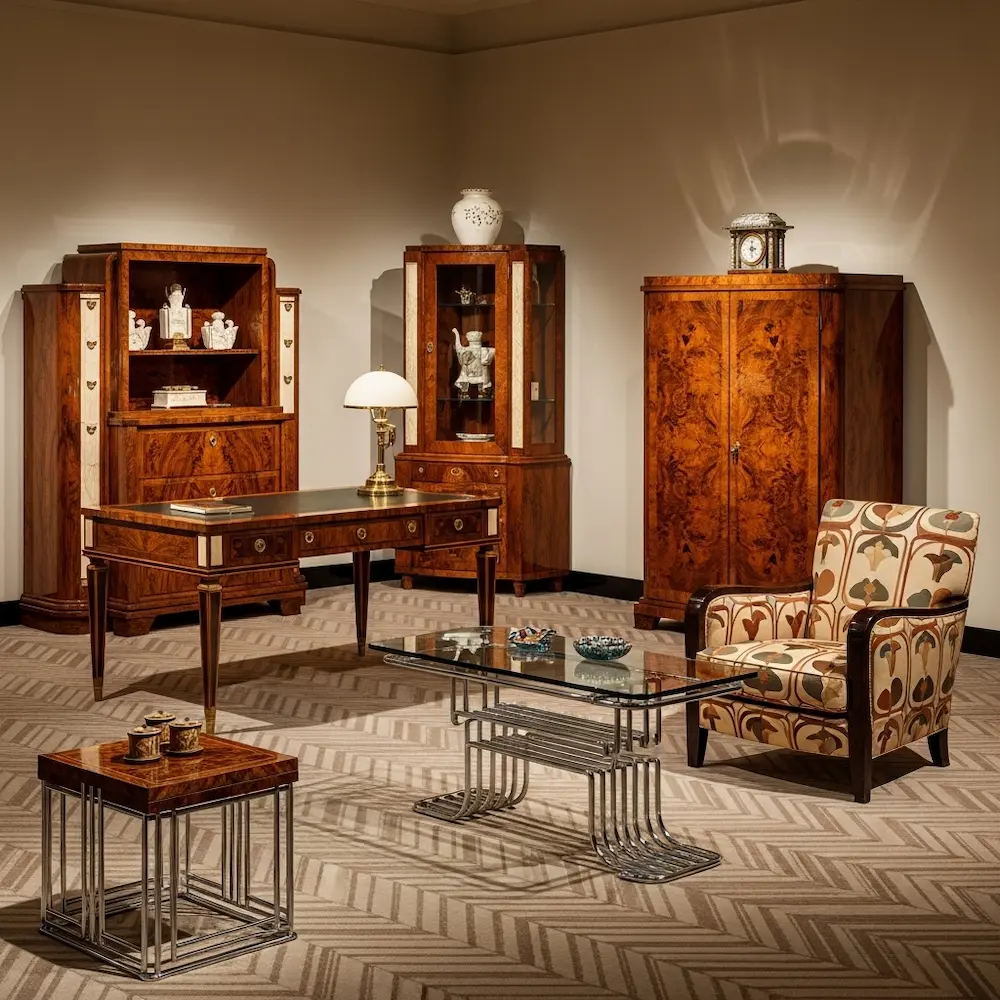
Émile-Jacques Ruhlmann (1879-1933) stands as art deco furniture design’s greatest master. The Victoria & Albert Museum describes him as “regarded as a master of high-end, handcrafted interiors, best known for his elegant lines and exotic wood veneers. He referred to his richest creations as his ‘precious pieces'”.
Ruhlmann’s furniture philosophy emphasized perfect proportions with furniture scaled to human use yet maintaining sculptural presence, exotic materials including Macassar ebony, amboyna burl, and other rare veneers, impeccable craftsmanship with invisible joinery and mirror-smooth finishes, elegant simplicity avoiding excessive ornamentation, and ivory accents providing subtle decorative interest. His workshops employed dozens of master craftspeople maintaining 18th-century standards while creating thoroughly modern forms.
Signature pieces included his “Grand Bureau” (1923) demonstrating perfect proportions and exotic veneers, the “Cabinet d’Un Collectionneur” pavilion at the 1925 Paris Exposition showcasing complete interiors, elegant dining tables with tapered legs and luxurious surfaces, and sleek cabinets with minimal hardware emphasizing wood beauty. Ruhlmann’s work commanded premium prices in his lifetime and remains highly sought by collectors, with major pieces selling for hundreds of thousands at auction.
Jacques-Émile Ruhlmann: Bridging Tradition and Modernity
Jacques-Émile Ruhlmann (often confused with Émile-Jacques; sources vary on naming) created furniture bridging 18th-century French traditions with modern art deco aesthetics. His work demonstrated how art deco could honor craft traditions while embracing contemporary forms.
Ruhlmann’s designs featured slender tapering legs showing neoclassical influence, geometric inlays in contrasting materials, luxurious upholstery in silk and velvet, and restrained ornamentation allowing forms and materials to dominate. His client list included wealthy industrialists, luxury ocean liners, and fashionable Paris establishments.
Paul Follot: Colorful Traditionalist
Paul Follot (1877-1941) approached art deco furniture from decorative arts traditions rather than avant-garde modernism. Unlike minimalist designers, Follot celebrated color, pattern, and ornament within geometric frameworks.
Follot’s work incorporated polychromatic fabrics and textiles, floral motifs stylized geometrically, elaborate carved details on furniture, and coordination of furniture with complete room schemes. He directed the Pomone workshop at Le Bon Marché department store, making art deco accessible to broader audiences through more affordable pieces. His colorful approach influenced how art deco interiors balanced geometric severity with decorative richness.
Eileen Gray: Modernist Furniture Pioneer
Eileen Gray (1878-1976) created furniture that bridged art deco and modernism, influencing both movements. Her work demonstrated art deco’s capacity for functional innovation alongside aesthetic sophistication.
Gray’s furniture featured tubular steel and glass combinations anticipating International Style, lacquerwork applying traditional Japanese techniques to modern forms, adjustable and transformable pieces emphasizing functionality, and geometric forms prioritizing use over decoration. Her E-1027 table (1927) became a modernist icon, while her lacquer screens and panels showed art deco’s decorative possibilities. As both designer and manufacturer, Gray controlled every aspect of production, ensuring uncompromising quality.
Jewelry Designers: Geometric Gems and Precious Metals
Art deco jewelry design reached extraordinary refinement as famous art deco designers translated geometric principles into wearable art. Major jewelry houses created pieces that remain iconic.
Cartier: House of Innovations
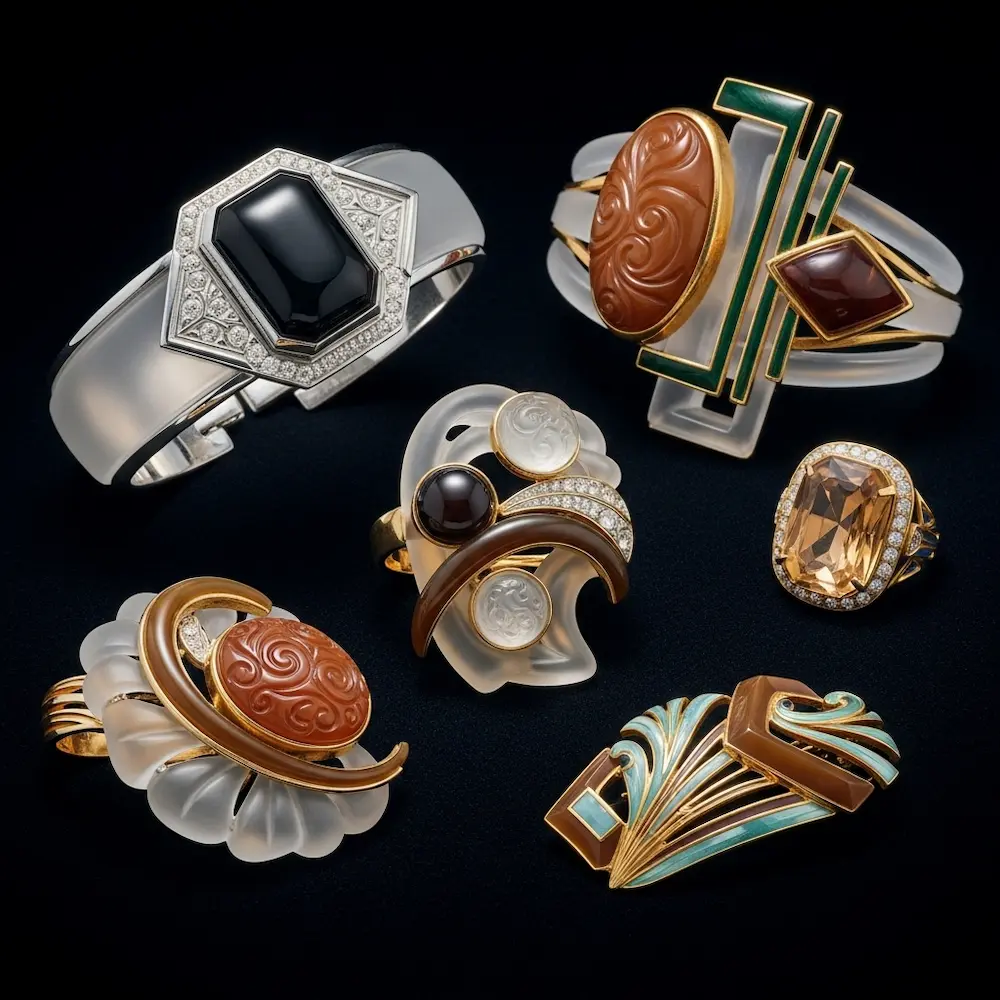
Cartier dominated art deco jewelry through continuous innovation and impeccable execution. As Windsor Jewelers explains, “Cartier Art Deco jewelry was inspired by the arts in the Far East and the Orient, showcasing intricate motifs and bold color schemes where colored gemstones were the spotlight”.
Louis Cartier (1875-1942) led the house through art deco’s golden age, pioneering platinum settings allowing delicate geometric designs, calibré-cut gemstones precisely shaped to fit patterns, exotic influences from Egyptian, Indian, and Asian art, and bold color combinations contrasting diamonds with emeralds, rubies, and sapphires. The famous Cartier “Tutti Frutti” style brought “carved emeralds, rubies and sapphires adapted from Indian jewels together in riotous combination from the mid 1920s”.
Jeanne Toussaint (1887-1978), Cartier’s creative director from 1933, defined the house’s most recognizable aesthetic. Sotheby’s notes her “joie de vivre, relentless creativity and eye for contemporary fashions, especially the graphic and geometric Art Deco movement” shaped “one of the most recognisable and collectible eras in the house’s history”. Her panther motif became Cartier’s signature, while her geometric designs influenced decades of jewelry fashion.
Charles Jacqueau (1885-1968) served as Cartier’s chief designer, translating Louis Cartier’s and Toussaint’s concepts into technical drawings. His drafting skills enabled Cartier’s most complex geometric settings and innovative constructions.
Van Cleef & Arpels: Technical Innovation
Van Cleef & Arpels pioneered technical innovations defining art deco jewelry. The house developed the Mystery Set technique (invisible setting) allowing gemstones to appear suspended without visible prongs, minaudière cases combining jewelry and functional objects, and transformation jewelry converting between necklaces, bracelets, and brooches. These technical achievements complemented pure aesthetic innovation, making Van Cleef & Arpels essential to art deco jewelry’s development.
René Boivin and Suzanne Belperron: Bold Creativity
The House of René Boivin “stood as an exemplar of creativity and innovation during the Art Deco”. Under Jeanne and René Boivin’s leadership, the atelier produced “bold and avant-garde designs, characterized by geometric motifs and the use of high-quality materials”.
Suzanne Belperron (1900-1983), working at Boivin in the 1920s, “left an indelible mark on the industry” by “redefining Art Deco aesthetics, blending bold geometric forms with fluid lines”. Her work demonstrated how art deco jewelry could balance geometry with organic curves, creating pieces that felt both modern and timeless.
René Lalique: Glass and Jewelry Master
René Lalique (1860-1945) transitioned from Art Nouveau jewelry to art deco glass, becoming one of the era’s most versatile famous art deco designers. His jewelry featured innovative materials including glass, horn, and enamel combined with precious stones, nature-inspired motifs geometrically stylized, and sculptural three-dimensional forms. Moving into glass, Lalique created iconic perfume bottles for major fragrance houses, art deco glass panels for architecture including the Normandie ocean liner, and decorative objects bringing art deco to middle-class homes.
Graphic Designers and Visual Artists
Art deco’s graphic designers elevated commercial art to fine art status while creating the era’s most recognizable visual communications. Several artists dominated this field, as explored in depth in our article on art deco graphic design style.
A.M. Cassandre: Poster Art Master
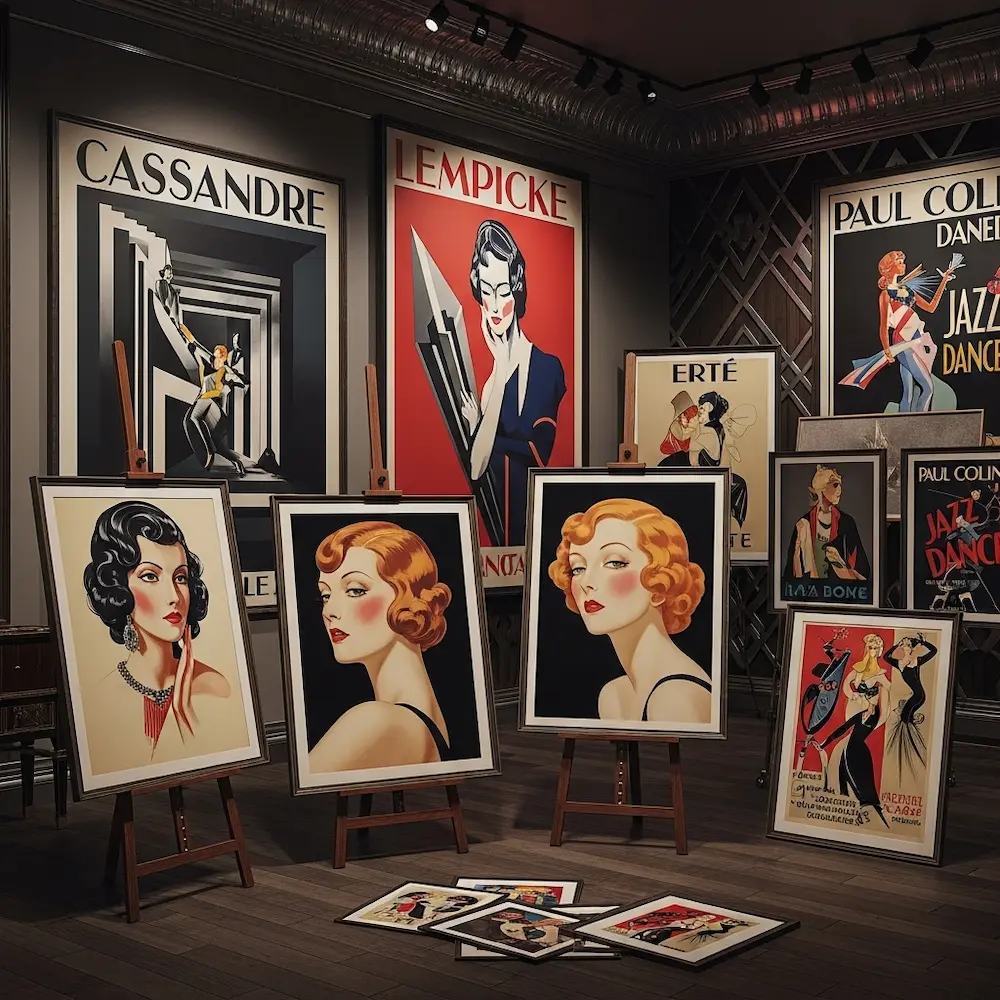
A.M. Cassandre (Adolphe Jean-Marie Mouron, 1901-1968) created poster designs that defined art deco graphic aesthetics. His geometric compositions with dramatic perspective, bold typography integrated into images, limited color palettes with maximum impact, and streamlined forms suggesting speed and modernity established conventions others followed. Cassandre’s Normandie, Nord Express, and Dubonnet posters remain iconic nearly a century after creation.
Tamara de Lempicka: The Baroness with a Brush
Tamara de Lempicka (1898-1980) painted portraits and figures that embodied art deco’s glamorous sophistication. Artsper describes her as “The Baroness with a Brush,” noting her distinctive style. Her work featured geometric simplification of human forms, bold colors and dramatic lighting, modern women in luxurious settings, and Cubist influences adapted to figurative painting. Lempicka’s paintings decorated art deco interiors and illustrated magazines, making her one of few fine artists fully integrated into art deco’s commercial success.
Erté: Extravagant Costume Designer
Erté (Romain de Tirtoff, 1892-1990) created fashion illustrations, costume designs, and decorative arts that epitomized art deco’s theatrical glamour. His work included elaborate costume designs for theater and film, fashion illustrations for Harper’s Bazaar spanning decades, sculptural designs translating art deco motifs into three dimensions, and graphic works featuring elongated figures in dramatic poses. Erté’s extravagant aesthetic defined art deco’s most opulent manifestations.
Paul Colin: Theatrical Posters
Paul Colin (1892-1985) designed theatrical posters that captured Jazz Age entertainment’s energy. His work for Parisian theaters and cabarets featured stylized figures suggesting dance and movement, bold typography and geometric compositions, and celebration of jazz and modern music. Colin’s posters documented art deco’s entertainment culture while contributing to its visual development.
Fashion Designers and the Art Deco Silhouette
Fashion designers translated art deco’s geometric principles into wearable form, creating the era’s distinctive silhouettes. While fashion history recognizes many contributors, certain designers particularly embodied art deco aesthetics.
Coco Chanel: Modern Simplicity
Coco Chanel (1883-1971) revolutionized women’s fashion with geometric simplicity that paralleled art deco design. Her straight-line dresses eliminating Victorian curves, use of jersey and simple fabrics emphasizing form over decoration, geometric jewelry including costume pieces making modern design accessible, and overall aesthetic valuing elegant simplicity over elaborate ornament aligned perfectly with art deco principles. Chanel’s designs freed women physically while visually embodying modernity.
Jean Patou: Sportswear Innovator
Jean Patou (1880-1936) created sportswear and day dresses reflecting art deco’s streamlined aesthetic. His geometric knit patterns, dropped-waist dresses in art deco silhouettes, and integration of modern materials paralleled architectural and furniture design’s embrace of new forms and materials. Patou dressed the modern woman living the active lifestyle art deco celebrated.
Paul Poiret: Theatrical Elegance
Paul Poiret (1879-1944) bridged Art Nouveau and art deco, bringing Eastern influences and theatrical drama to fashion. His work influenced art deco fashion’s exotic elements and established fashion as art worthy of serious attention. Though his star faded as Chanel’s simpler aesthetic dominated the 1920s, Poiret’s earlier innovations enabled art deco fashion’s emergence.
Le Corbusier: Architect, Designer, Theorist
Le Corbusier (Charles-Édouard Jeanneret, 1887-1965) occupied unique position among famous art deco designers. While primarily associated with International Style modernism, his 1920s work intersected significantly with art deco.
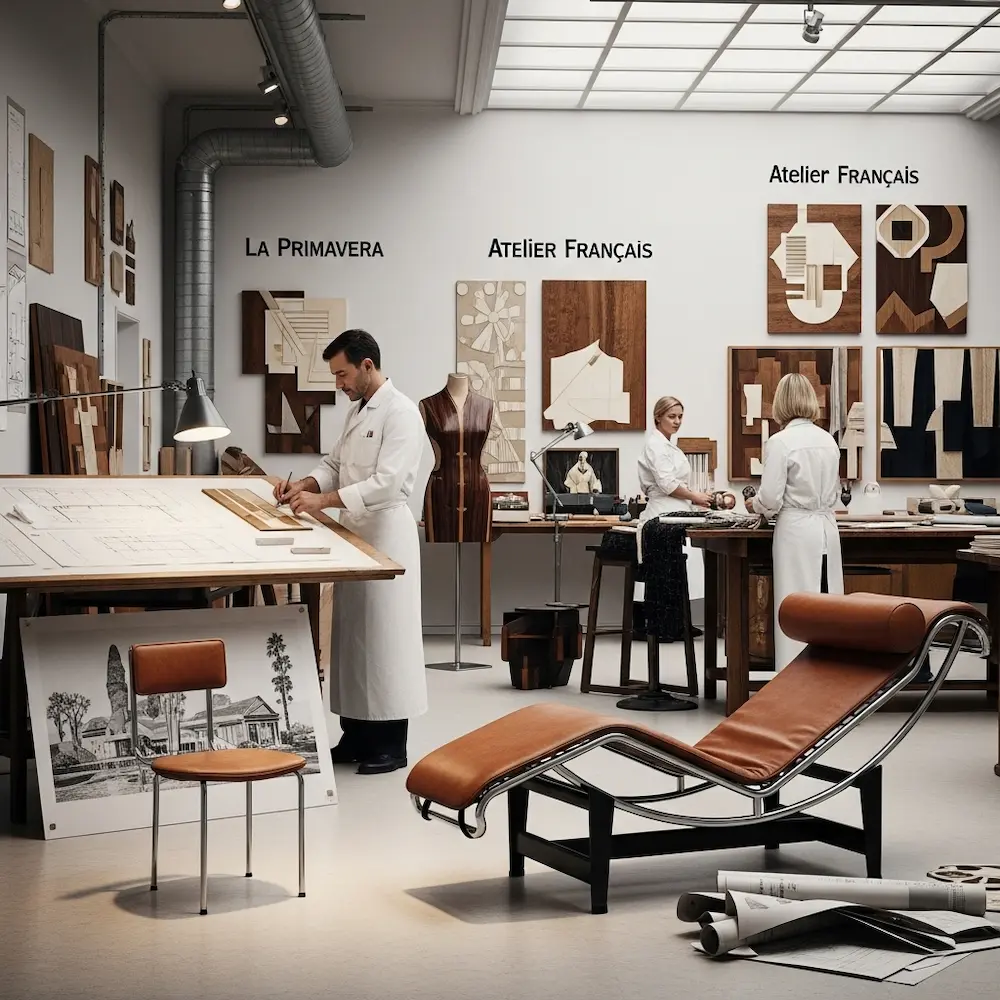
Le Corbusier’s furniture designs with Charlotte Perriand including the LC2 and LC4 lounges combined geometric forms with modern materials. His Pavilion de l’Esprit Nouveau at the 1925 Paris Exposition presented minimalist alternative to ornate art deco. His architectural theory emphasizing geometric purity and machine-age aesthetics influenced how art deco evolved from 1920s opulence toward 1930s streamlining. As Artsper notes, Le Corbusier was “The Man Behind the Art Deco Living Room,” shaping how art deco interiors balanced decoration with modern functionality.
Collaborative Networks and Design Studios
Art deco designs often emerged from collaborative workshops rather than individual creators. Understanding these networks reveals how art deco developed through shared innovation.
Parisian Department Store Workshops
Major Parisian department stores operated design workshops employing hundreds of artists. La Primavera at Printemps, Pomone at Le Bon Marché, Studium at Louvre department store, and Maîtrise at Galeries Lafayette all produced furniture, textiles, and decorative objects bringing art deco to middle-class consumers. Wikipedia notes that “By 1920, Primavera employed more than 300 artists, whose styles ranged from updated versions of Louis XIV, Louis XVI, and especially Louis Philippe furniture made by Louis Süe and the Primavera workshop, to more modern forms”.
These workshops democratized art deco, translating haute design into affordable mass production. They also trained new generations of designers and disseminated art deco principles widely.
Atelier Français and Collaborative Groups
Designers formed collaborative studios sharing costs and expertise. The Atelier Français combined Louis Süe and André Mare, who “made their first appearance at the 1912 exhibit…combining polychromatic fabrics with exotic and expensive materials, including ebony and ivory. After World War I, they became one of the most prominent French interior design firms, producing the furniture for the first-class salons and cabins of the French transatlantic ocean liners”.
These collaborations enabled comprehensive interior designs where furniture, textiles, lighting, and architectural elements worked together as unified compositions.
Crossword Fame: “Famed Art Deco Designer Crossword”
Interestingly, art deco designers’ names frequently appear in crossword puzzles, particularly the clue “famed art deco designer crossword”. Common answers include:
- ERTÉ (4 letters) – most frequent due to unusual spelling
- CASSANDRE (9 letters) – for longer answers
- LALIQUE (7 letters) – recognized jewelry/glass designer
- RUHLMANN (8 letters) – furniture master
This crossword presence demonstrates how certain famous art deco designers achieved name recognition beyond design specialists, their distinctive names becoming part of puzzle culture.
Legacy and Continuing Influence
The famous art deco designers profiled here created works that transcend historical documentation to remain actively influential. Contemporary designers studying Ruhlmann learn furniture proportion, examining Cassandre posters teaches graphic composition, analyzing Cartier jewelry reveals how geometry can be luxurious rather than cold, and understanding Van Alen’s Chrysler Building shows how commercial architecture can achieve artistic significance.
Museums worldwide hold major art deco collections honoring these designers. The Victoria & Albert Museum, Metropolitan Museum of Art, Musée des Arts Décoratifs in Paris, and numerous smaller institutions preserve and display their work. Auction houses regularly feature art deco pieces, with Ruhlmann furniture, Cartier jewelry, and major architectural elements commanding substantial prices reflecting enduring appreciation.
Conclusion
The famous art deco designers and architects explored here—from Van Alen’s soaring Chrysler Building to Ruhlmann’s exquisite furniture, from Cartier’s geometric jewelry to Cassandre’s iconic posters—collectively created art deco’s visual vocabulary while pursuing individual artistic visions. Understanding these creative individuals—their training, influences, signature techniques, major works, and interactions with each other—illuminates how art deco emerged as coherent movement despite spanning architecture, furniture, jewelry, graphics, and fashion across multiple continents.
These designers worked during extraordinary historical circumstances—post-World War I optimism, technological transformation, social modernization, and unprecedented wealth concentration—that enabled both ambition and patronage. The 1925 Paris Exposition brought many together, creating networks of influence and competition that accelerated innovation. The Depression’s economic collapse ended art deco’s golden age but couldn’t erase the magnificent legacy these designers created during their brief creative flowering.
Whether exploring art deco interior design influenced by Ruhlmann and Gray, studying art deco graphic design style shaped by Cassandre and Colin, examining art deco jewelry designs perfected by Cartier and Lalique, or appreciating architecture by Van Alen and Mallet-Stevens, understanding the individual creators behind these works enriches appreciation of art deco designs as products of specific talented individuals working at the peak of creative possibility. Their collective achievement remains one of design history’s most glamorous chapters, their works continuing to inspire designers pursuing that elusive combination of geometric precision and luxurious beauty that defines art deco at its finest.


