

Masters in Graphic Design Online: Flexible Paths to Advanced Design Study
Table of Contents
A masters in graphic design online lets you earn an advanced design qualification without relocating or pausing your career, using virtual studios, live critiques, and project-based learning to mirror the on‑campus experience. In 2025, accredited universities worldwide offer online masters degree in graphic design options that blend flexible schedules with rigorous curricula and professional mentoring. This guide is part of our comprehensive resource on masters in graphic design and focuses specifically on the online format—how it works, what you learn, what it costs, and who it suits best.
Understanding Masters in Graphic Design Online
Online masters in graphic design programs are structured to deliver graduate‑level studio and theory content through digital platforms while maintaining academic standards equivalent to campus-based degrees. Students attend live seminars, participate in critique sessions, submit projects via learning management systems, and collaborate with peers in virtual classrooms. Many universities explicitly state that online students receive the same curriculum and degree title as on-campus cohorts, often taught by the same faculty.
Online programs typically combine asynchronous lectures—recorded content you can watch anytime—with scheduled live workshops and critiques to ensure real-time feedback on work in progress. This model is particularly attractive for working professionals, parents, and international students who need schedule flexibility but still want a structured, high‑level learning environment. For an overview of degree types and formats (MFA, MA, MDes) beyond the online focus, refer back to the main guide on masters in graphic design.
Degree Types and Formats Available
Different institutions brand their masters degree online in graphic design in various ways, including MA, MFA, and specialized master’s titles.
- Some schools, like Academy of Art University, offer both an online MA and an online MFA in Graphic Design, with the MFA emphasizing thesis development and extended studio practice over more semesters.
- European providers such as LABASAD and UCA offer online Master in Graphic and Digital Design or MA Graphic Design degrees structured around modular projects instead of traditional studio semesters.
You’ll also find related programs in interactive media, web design, and media design that heavily overlap with graphic design, such as Quinnipiac’s online MS in Interactive Media and University of Florida’s MA in Web Design & Online Communication. These are particularly relevant if you want to blend visual communication with UX, front‑end design, or digital strategy rather than pure print or branding work.
Who Online Masters Programs Are Designed For
High‑quality online masters in graphic design online programs are built with mid‑career professionals and career‑switchers in mind.
- Working designers who want to step into senior or strategic roles without leaving their current jobs benefit from part‑time online study and asynchronous content.
- International students who want a US‑ or UK‑accredited qualification but cannot relocate can join global cohorts and build international networks through fully remote delivery.
- Career changers can use structured online degrees to transition into design from adjacent fields, supported by portfolios developed around real briefs and capstone projects.
By design, these programs emphasize flexibility, remote collaboration, and digital presentation skills, which directly reflect the realities of contemporary design teams that often work across locations and time zones.
Curriculum and Learning Experience in Online Programs
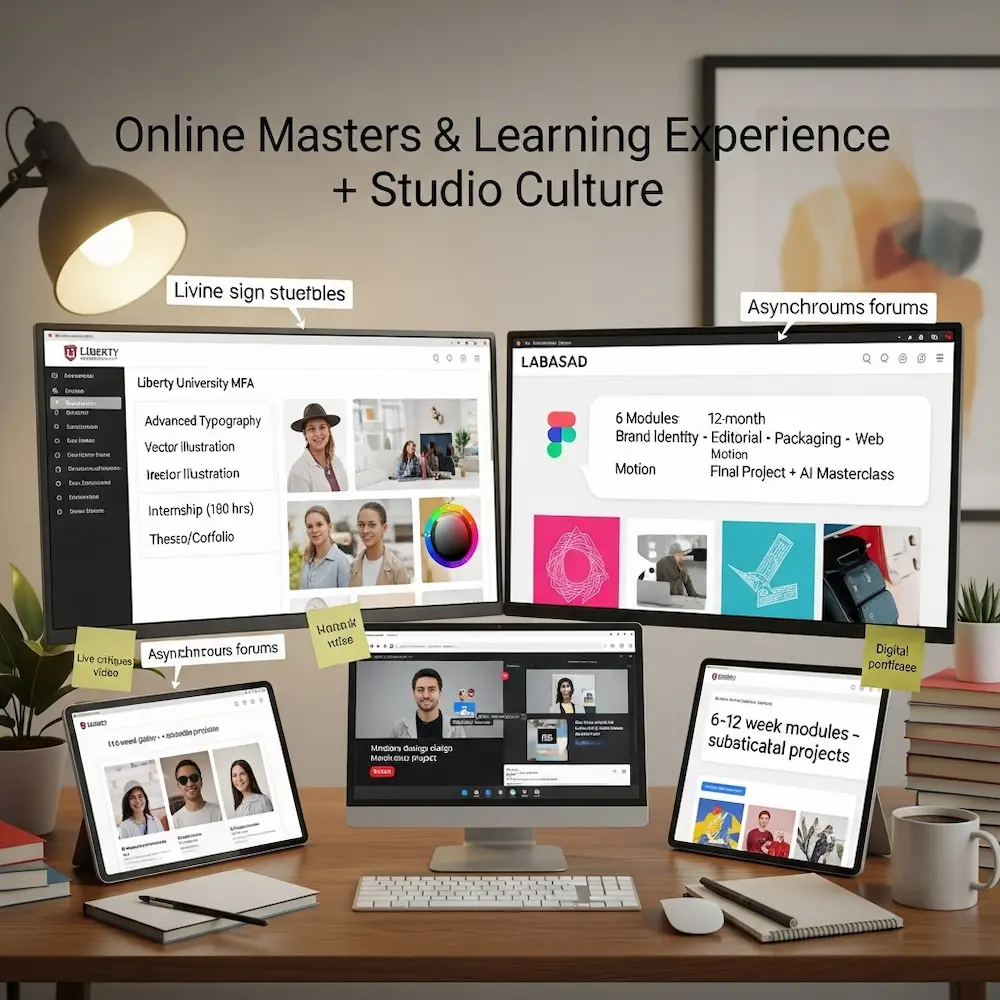
While each institution structures its curriculum differently, most online masters in graphic design programs cover a blend of advanced visual practice, design thinking, and professional development. Programs are typically organized into modules or courses that run over 6–12 weeks, each focused on specific skill areas and culminating in substantial project outcomes.
Online curricula usually include:
- Advanced typography and type systems
- Brand identity and visual strategy
- Editorial and digital publication design
- Interaction/UX fundamentals and interface layout
- Motion design, animation, or media design
- Design research methods, critical theory, and writing
- Portfolio development and major project or thesis
Examples of Online Masters Curricula
Different universities illustrate how diverse online learning paths can be while still falling under the umbrella of a masters in graphic design online.
- Liberty University’s online MFA in Graphic Design includes training in digital art, 3D, vector illustration, game design, and publication design, alongside a 180‑hour internship and either a thesis or portfolio project, with all didactic coursework delivered 100% online.
- LABASAD’s Online Master in Graphic and Digital Design runs for 12 months and is composed of 12 courses grouped into 6 modules, covering brand identity, editorial design, packaging, web design, motion design, and a final master’s project, plus a dedicated AI & Graphic Design masterclass cluster.
These examples show how online programs often combine traditional graphic design foundations with digital‑first skills—web and interface work, motion, and AI integration—to ensure graduates are prepared for contemporary practice.
Studio Culture, Critique, and Collaboration Online
Critique and peer interaction are central to graduate design education, and well‑designed online programs replicate studio culture with digital tools.
- Live critique sessions via video conferencing allow you to present work, receive verbal and visual feedback, and engage in group discussions about concept, craft, and context.
- Discussion forums and shared workspaces enable asynchronous critique, where you can comment on classmates’ iterations and iterate based on written feedback.
Virtual exhibitions and online portfolio showcases are increasingly common, with some schools organizing digital galleries or public project sites where student work is curated and shared with industry mentors. This environment builds your ability to present and explain work clearly via screen‑based formats, an essential skill in remote or hybrid design roles.
Admissions and Entry Routes
Admission into a masters in graphic design online is competitive but often more flexible than traditional programs in terms of timing and background diversity. Most institutions operate multiple intakes per year and accept applications on a rolling basis, making it easier to align your start date with professional or personal milestones.

Common Admission Requirements
Typical requirements for an online masters degree in graphic design include:
- A bachelor’s degree (often in graphic design, visual communication, arts, or related disciplines).
- A curated portfolio (usually 10–20 pieces) showing strong visual thinking, typographic sensitivity, and conceptual problem solving.
- Academic transcripts and proof of graduation.
- A statement of purpose or personal statement outlining motivations and professional goals.
- 1–3 letters of recommendation (academic or professional).
- For international applicants, proof of English proficiency (e.g., IELTS/TOEFL).
Some programs—especially those branded as digital design or web design—welcome applicants from non‑design backgrounds, provided they can demonstrate aptitude and a willingness to learn through tailored portfolios or preparatory work.
Application Timelines and Portfolio Tips
Online programs often allow you to start in fall, spring, or summer terms, and some offer rolling admissions with monthly or bi‑monthly start dates. This flexibility allows you to:
- Time your application around major client projects.
- Use a few months to strengthen your portfolio with self‑initiated briefs.
- Align your study with quieter periods in your professional calendar.
Your portfolio should emphasize narrative and process as much as final visuals: schools value evidence of research, ideation, iteration, and reflection. Including a range of work—branding, editorial, digital interfaces, motion, and experimental projects—demonstrates versatility, which is especially important when applying to broad online masters programs that serve diverse creative trajectories. For broader context on graduate-level portfolio expectations, the main masters in graphic design guide provides additional detail.
Costs, Affordability, and Return on Investment
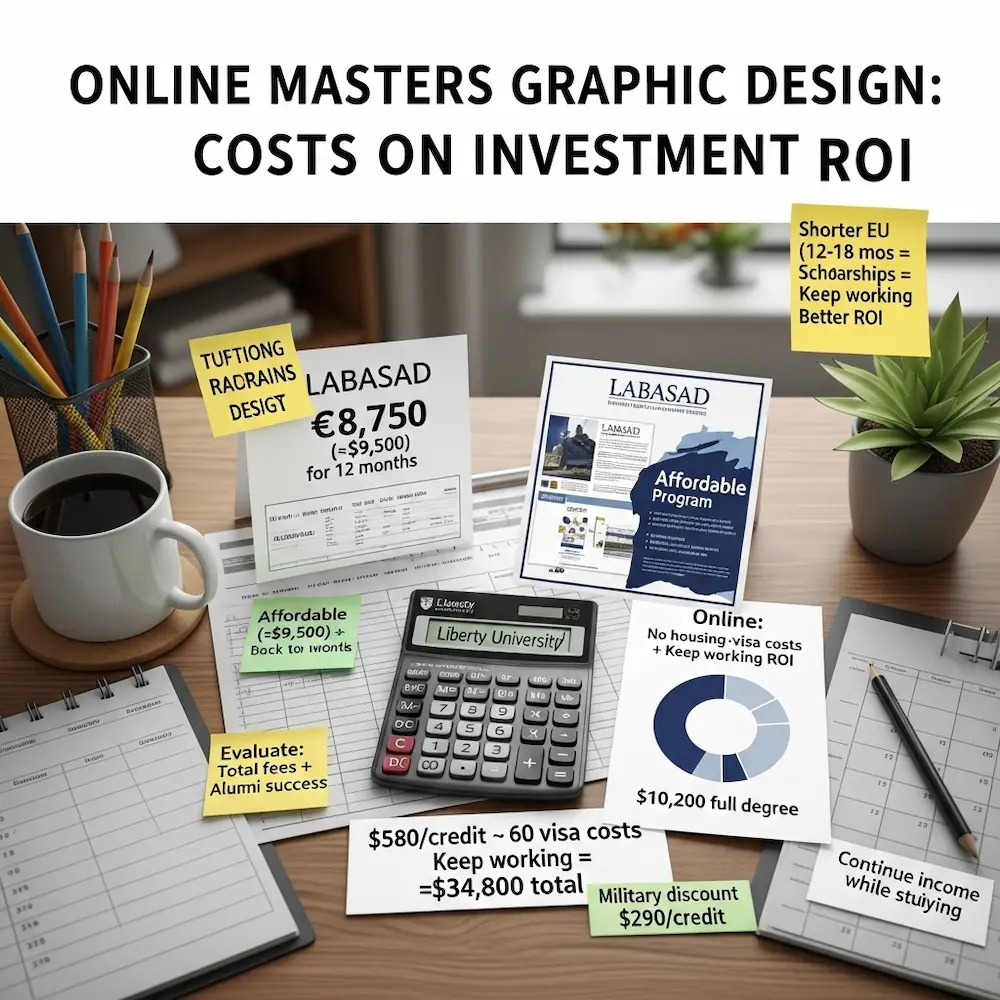
A major advantage of studying masters in graphic design online is the potential to reduce overall cost compared to relocating for an on‑campus program. While tuition can still be substantial, online delivery can eliminate or reduce housing, commuting, and visa costs, and allows many students to keep working while studying.
Typical Tuition Ranges and Examples
Across 2025 rankings, online masters graphic design tuition varies widely:
- Some online programs highlighted for affordability list tuition at roughly $10,200 for a full master’s degree, particularly at smaller or regional institutions.
- Larger private schools often charge per credit, such as Liberty University at around $580 per credit for a 60‑credit MFA, which is still positioned as comparatively affordable among US online offerings.
- More specialized or prestigious programs, especially in North America and Western Europe, can reach total tuition costs in the $20,000–$50,000+ range, depending on structure and degree type.
European providers like LABASAD and various UK universities commonly offer 12–18 month online masters that are shorter than many US MFAs, which may improve ROI by getting you back to full‑time professional focus earlier.
Evaluating Value for Money
To judge whether a masters degree online in graphic design is financially sensible, consider:
- Total tuition plus fees for the entire program, not just annual cost.
- Ability to keep working part‑ or full‑time while studying, limiting lost income.
- Scholarships, payment plans, and employer sponsorship, which some online programs are structured to accommodate.
- The program’s track record: alumni roles, portfolio quality, and recognition in rankings and industry lists.
Combining this article with the ROI analysis from the is a masters in graphic design worth it cluster page gives you a fuller financial picture when deciding between online and on‑campus routes.
Online Masters Graphic Design Programs in Florida and Beyond
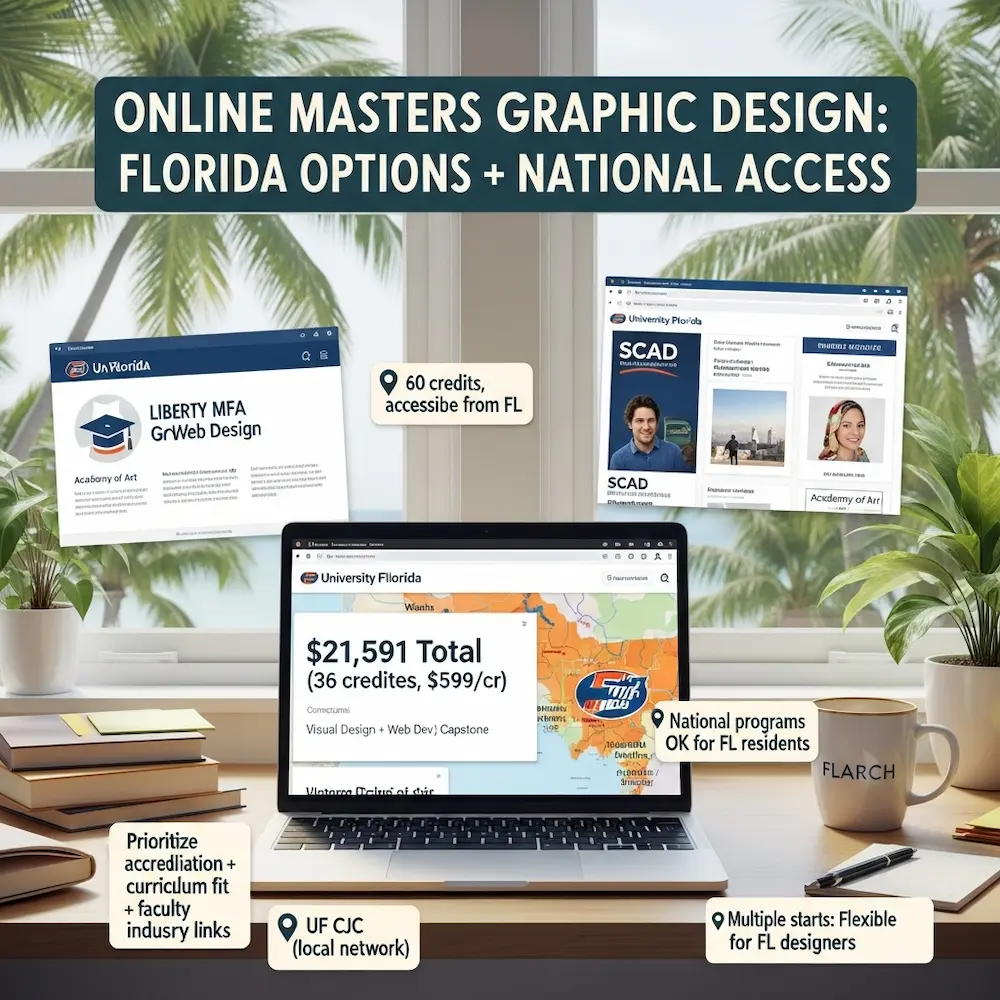
Many designers specifically search for an online masters graphic design program in Florida, either to stay close to regional networks or because they target US‑based clients and employers. Strictly speaking, relatively few programs are marketed as Florida‑only online MFAs in graphic design, but Florida‑based and Florida‑friendly options do exist in overlapping fields.
Florida-Linked and Florida-Friendly Options
Several universities and platforms offer programs that designers in Florida can use as functional equivalents to an online masters in graphic design:
- The University of Florida College of Journalism and Communications runs a 100% online MA in Web Design and Online Communication, combining visual design, communication theory, and web development with a practical capstone project and an approximate total cost of $21,591 for 36 credit hours.
- Other Florida institutions provide online or hybrid graduate programs in digital journalism, design, or media that integrate advanced design thinking and visual communication, which can suit designers leaning toward digital content and UX.
Because most nationally recognized online graphic design degrees accept students from all US states, Florida residents can also enroll in top‑ranked programs at Liberty, SCAD, Academy of Art, and European schools while staying physically in Florida. When your goal is to work in Florida’s design market rather than attend a Florida‑branded school, employer recognition of the institution and your portfolio strength matter far more than geography.
How to Select the Right Program
Whether you’re in Florida or elsewhere, prioritize these factors when choosing a masters in graphic design online:
- Accreditation and rankings: Look for regional/national accreditation and presence in reputable rankings of online design programs.
- Curriculum alignment: Ensure modules support your goals—brand identity, motion, UX/UI, editorial, or research‑driven practice.
- Delivery model: Decide whether you prefer asynchronous courses you can fit around unpredictable schedules or blended formats with fixed live sessions.
- Faculty and industry links: Favor programs where faculty have strong portfolios and industry experience, plus partnerships with agencies or brands.
The broader article on masters in graphic design can help you contextualize these online‑specific considerations within the full spectrum of graduate options.
Frequently Asked Questions about masters in graphic design online
What exactly is a masters in graphic design online?
A masters in graphic design online is a graduate‑level degree delivered through virtual platforms, where coursework, studio projects, critiques, and seminars are completed remotely rather than on campus. You access lectures, briefs, and readings via a learning management system, attend live sessions for critique and discussion, and submit work digitally for feedback from faculty and peers. In most reputable programs, the degree title and curriculum closely match the on‑campus version and are equally recognized by employers. For a deeper look at degree types overall, refer to our main guide on masters in graphic design.
Is an online masters degree in graphic design as respected as an on-campus degree?
When the program is properly accredited and offered by a recognized university, employers generally see an online masters degree in graphic design as equivalent to the on‑campus version. Hiring managers focus more on your portfolio, case studies, and professional experience than on whether you studied online or in person. Many schools explicitly state that online graduates receive the same diploma and follow the same learning outcomes as campus students. Emphasize your projects, capstone work, and internships rather than the delivery mode in your CV and portfolio.
How long does it take to complete a masters in graphic design online?
Duration varies by program, but most online masters in graphic design take 12–36 months depending on intensity and enrollment status. Intensive programs like LABASAD’s Online Master in Graphic and Digital Design are designed to be completed in 12 months full‑time and are structured around six practical modules leading to a final project. More traditional MA or MFA programs, such as those highlighted in US and UK rankings, often require 30–60 credits and can be finished in 16–24 months full‑time or 2–3 years part‑time. Check each university’s recommended study load and maximum completion period before enrolling.
What are the admission requirements for a masters degree online in graphic design?
Most programs require a bachelor’s degree, a design portfolio, transcripts, and a personal statement. Portfolios typically include 10–20 projects showing strong typography, layout, branding, and digital or interactive work. Some institutions ask for 1–3 references and a CV detailing professional experience. If you come from a non‑design background, you may still qualify by presenting self‑initiated projects and explaining your transition into design. International applicants usually need to demonstrate English proficiency via IELTS or TOEFL scores. General admissions principles for graduate design study are covered in more detail in the pillar article on masters in graphic design.
How much does an online masters in graphic design cost?
Costs vary widely by institution and region. Some affordable online programs cited in 2025 rankings list total tuition near $10,200 for the entire degree. Others, such as Liberty University’s online MFA in Graphic Design, charge approximately $580 per credit for 60 credits, giving a total in the mid‑five‑figure range. More premium or specialized programs, especially at private US or UK universities, can cost between $20,000 and $50,000+ for full completion. While online formats save on relocation and housing, you still need to budget for software, hardware upgrades, and potential reduced working hours during intense project periods. For ROI considerations across all formats, also see our article on whether a master’s is worth it.
Can I work full-time while enrolled in a masters in graphic design online?
Yes, many students deliberately choose an online masters in graphic design online so they can maintain full‑ or part‑time work. Programs that emphasize asynchronous lectures and flexible deadlines are specifically tailored for working professionals. However, graduate design work is demanding; expect to invest 10–20 hours per week in reading, research, and project development depending on your credit load. Choosing part‑time study, planning your workload around key project milestones, and negotiating realistic expectations with employers all improve your chances of successfully balancing both.
Are there online masters graphic design programs specifically for Florida students?
While pure online masters graphic design program in Florida options are limited, Florida designers can access several relevant paths. The University of Florida, for example, offers a fully online MA in Web Design & Online Communication that blends visual design, communication theory, and web development in a portfolio‑driven 36‑credit program. Florida residents can also enroll in national or international online graphic design masters from schools like Liberty, SCAD, Academy of Art, UAL, and LABASAD while remaining physically based in Florida. In practice, employer recognition of the institution, your portfolio quality, and your specialization matter more than whether the program is branded as “Florida‑based.”
What tools and software will I need for an online masters degree in graphic design?
You’ll need a capable computer, stable broadband, and access to industry‑standard design tools. Most programs expect students to work with Adobe Creative Cloud—Photoshop, Illustrator, InDesign, After Effects—as well as prototyping tools like Figma or Adobe XD for interface and digital product work. Some schools provide discounted software through institutional licenses; others require you to subscribe independently. Programs that incorporate AI design workflows may also use specialized AI platforms for image generation, layout support, or narrative development. Check the technical requirements section on each program’s site before applying.
How do online masters programs handle critique, collaboration, and networking?
Online masters programs recreate studio dynamics through live critique sessions, group projects, and digital collaboration spaces. Video‑based critiques allow you to present work in real time, share your screen, and receive verbal feedback from faculty and classmates. Asynchronous discussion forums and shared project boards support ongoing peer review and iterative development between live sessions. Many programs also host virtual events—guest lectures, portfolio days, and online exhibitions—providing networking opportunities with industry professionals across countries and time zones. In some cases, you may also arrange local internships or remote client projects to build experience alongside your studies.
Conclusion
Choosing a masters in graphic design online can be a powerful way to deepen your design expertise, expand your portfolio, and gain a recognized graduate credential without sacrificing location independence or current work. Well‑designed online programs now deliver rigorous studio experiences, robust critique culture, and strong professional links through virtual campuses and global cohorts. For designers in markets like Florida or those targeting North American and European clients from abroad, online study offers access to institutions and networks that might otherwise be out of reach.
The key is to vet programs carefully: confirm accreditation, analyze curricula against your goals, compare costs and funding options, and examine faculty backgrounds and alumni outcomes before committing. If you want a full overview of how online degrees fit within broader graduate options, revisit the hub article on masters in graphic design. For help evaluating whether the investment makes sense for your career and finances, explore the dedicated guide on whether a master’s is worth it, and when you are ready to compare specific institutions and degree types, consult your cluster article on masters programs in graphic design. Use these resources together to choose a path that aligns with your creative ambitions and long‑term professional strategy.


