

Masters in Graphic Design Requirements: Complete Admission Guide
Table of Contents
Masters in graphic design requirements vary by institution but consistently emphasize creative potential, technical skills, and professional readiness over strict academic metrics. Graduate programs seek applicants who demonstrate strong visual thinking, conceptual problem-solving, and a clear artistic voice through their portfolios, rather than perfect GPAs or test scores. This comprehensive guide breaks down every component of the application process—from portfolio standards to statement of purpose strategies, eligibility criteria, and testing requirements. This guide is part of our comprehensive resource on masters in graphic design and provides the detailed application roadmap referenced in the main pillar content.
Academic Prerequisites and Eligibility

Most masters in graphic design eligibility criteria center around a bachelor’s degree and demonstrated creative aptitude, though programs differ in their flexibility regarding undergraduate majors and minimum GPAs. Virtually all accredited programs require a bachelor’s degree from a regionally accredited institution, but the field of study can vary widely—from fine arts and graphic design to communications, liberal arts, or even unrelated disciplines if supported by exceptional portfolios.
Programs typically expect a minimum GPA of 3.0 (on a 4.0 scale), though competitive applicants often exceed 3.5, particularly at top-ranked institutions like RISD, Yale, or Pratt. Some schools publish specific minimums—Boston University requires a 3.0 cumulative GPA, while others evaluate transcripts holistically alongside creative work. International applicants must submit credential evaluations through services like WES to confirm degree equivalency.
Minimum GPA and Transcript Evaluation
Admissions committees review your entire academic history, not just final GPA.
- Strong performance in design studios, art history, typography, or digital media courses carries more weight than unrelated subjects.
- Upward trends in GPA during junior and senior years can offset weaker early performance.
- International transcripts require line-by-line evaluations from NACES-approved services to ensure comparability.
Schools like SCAD and CalArts emphasize that while minimum GPAs exist, portfolio quality ultimately determines admission decisions.
Can You Apply Without a Design Bachelor’s Degree?
Yes—many programs explicitly welcome applicants from non-design backgrounds.
- Art history, communications, or liberal arts majors often qualify with strong self-initiated portfolios demonstrating design skills.
- Career changers from marketing, advertising, or tech can succeed by creating 10-15 targeted design projects before applying.
- Programs like Parsons and Pratt accept diverse majors when portfolios show conceptual thinking, typography sensitivity, and visual problem-solving.
The key is demonstrating equivalent preparation through work samples, online courses, or professional experience that evidences your readiness for graduate-level study.
The Portfolio: Your Most Critical Application Component
The portfolio represents 70-90% of admissions decisions in graphic design graduate programs, serving as both skill demonstration and artistic voice showcase. Admissions committees seek evidence of original thinking, technical mastery, typographic sensitivity, and conceptual depth across 15-25 projects that span print, digital, motion, and experimental work.
Faculty explicitly state they prioritize process documentation—sketches, iterations, research, and rationale—over polished final outcomes. Each project should include 1-3 slides showing the brief, your approach, key decisions, and results, typically formatted as a single PDF (20-50MB) or online platform submission.
What Makes a Strong Graduate Portfolio
Top portfolios demonstrate specific qualities admissions committees seek:
- Breadth and depth: Include typography studies, branding systems, editorial layouts, digital interfaces, and motion graphics.
- Conceptual thinking: Projects that solve real problems through research, not just visual decoration.
- Voice and originality: Work that reveals your unique perspective rather than following trends.
- Technical range: Proficiency across Adobe Suite, Figma, After Effects, and potentially 3D or prototyping tools.
Avoid generic student assignments; prioritize self-initiated, professional, or competition work that shows independent thinking.
Portfolio Formatting and Technical Standards
Follow these technical specifications used by most programs:
- 15-25 projects maximum, each with 1-4 slides showing process + outcome.
- PDF format (horizontal orientation, 72-150 DPI) or specified platforms like SlideRoom.
- Consistent presentation: Same font families, clear image/project hierarchy, brief captions (50-100 words each).
- No pre-made templates: Custom layouts that demonstrate your design thinking.
SCAD specifies “no scanned slides or low-res images,” while RISD emphasizes “work that shows your ability to think visually and solve problems creatively”.
Statement of Purpose and Written Materials
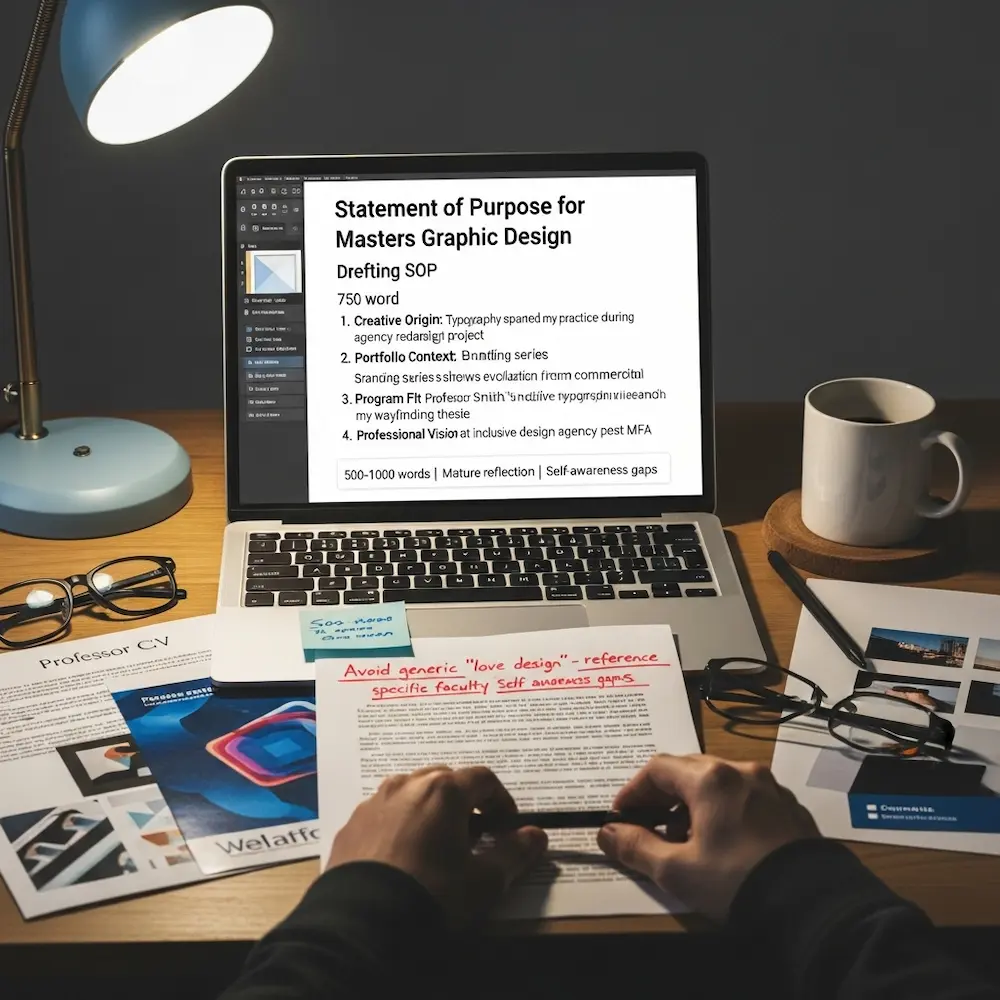
The statement of purpose for masters in graphic design (500-1000 words) explains your creative motivations, professional goals, and fit with the specific program. Unlike undergraduate essays, graduate statements should demonstrate mature reflection on design’s cultural role, your artistic evolution, and specific reasons for choosing that institution’s faculty, facilities, or philosophy.
Avoid generic “I love design” narratives; instead, reference specific professors, recent exhibitions, or program strengths that align with your practice. Committees seek evidence of self-awareness about your strengths, weaknesses, and how graduate study addresses specific gaps in your development.
Crafting a Compelling Statement of Purpose
Structure your statement around these elements:
- Creative origin story: What sparked your design practice and sustained your commitment?
- Portfolio context: How your submitted work represents your current practice and future direction.
- Program fit: Specific faculty, courses, or facilities that address your development needs.
- Professional vision: Concrete career goals that graduate study enables (teaching, creative direction, specialization).
Be specific: “Professor Smith’s research on inclusive typography directly informs my interest in accessible wayfinding systems” carries more weight than vague enthusiasm.
Letters of Recommendation Strategy
Secure 2-3 letters from sources who can speak to your creative abilities:
- Design professors who taught studio courses and can evaluate your growth.
- Professional supervisors from internships, freelance, or agency work.
- Avoid generic academic references from unrelated fields.
Provide recommenders with your portfolio, statement draft, and program-specific criteria 4-6 weeks before deadlines.
Standardized Testing: GRE and Beyond
The masters in graphic design GRE requirement has largely disappeared, with over 90% of programs now test-optional or test-blind. Design schools prioritize creative work over standardized metrics, recognizing that portfolios better predict graduate success than test scores.
A small number of hybrid programs (e.g., those with substantial theory components) may still request GRE scores, typically requiring 300+ combined verbal/quantitative. International applicants universally need English proficiency proof via TOEFL (90-100+), IELTS (6.5-7.0), or Duolingo (120+) unless they completed degrees in English-speaking countries.
When GRE Scores Still Matter
Submit GRE scores strategically if:
- Your GPA falls below program minimums (scores can demonstrate academic capability).
- You apply to programs explicitly listing GRE as recommended.
- Quantitative scores above 155 strengthen applications to computationally-oriented design programs (data visualization, generative design).
Most schools now state “GRE not required and not considered” in their requirements.
English Proficiency for International Applicants
Non-native speakers must demonstrate academic English proficiency:
- TOEFL iBT: 90-100 minimum (writing/speaking subscores often 22-25+).
- IELTS Academic: 6.5-7.0 overall (no subscore below 6.0).
- Duolingo English Test: 120+ (widely accepted by art/design programs).
Waivers apply to applicants with degrees from English-medium institutions or substantial professional experience in English-speaking environments.
Application Process Timeline and Logistics
Graduate design applications follow structured timelines, typically with deadlines 9-12 months before program start. Most US programs use centralized platforms like SlideRoom ($70-100 fees) alongside university portals for transcripts and recommendations.
Fall admissions (most common) have December-January deadlines, while some schools offer spring/summer entry with rolling admissions. International applicants should start 12-15 months early to accommodate visa processing and credential evaluations.
Step-by-Step Application Timeline
Follow this 12-month roadmap:
12-9 months out: Research programs, refine portfolio, draft statement.
9-6 months out: Request recommendations, take English tests if needed.
6-3 months out: Finalize portfolio PDF, submit applications (aim for 5-8 programs).
3 months out: Prepare for interviews, submit financial aid forms.
Budget $500-1000 total for fees, evaluations, and portfolio printing.
Interviews and Portfolio Reviews
30-50% of applicants receive interviews—virtual, phone, or in-person.
- Prepare to discuss 3-5 portfolio highlights in depth (process, decisions, outcomes).
- Know the program: Reference specific faculty or recent graduate exhibitions.
- Practice articulating your voice: “Why this program? Why now?”
CalArts and ArtCenter emphasize that interviews assess communication skills essential for professional practice.
Financial Documentation and Aid Applications
Beyond admission requirements, graduate programs require proof of financial resources for F-1 visa eligibility (international students) and separate aid applications. US programs typically require bank statements showing $50,000-80,000+ USD available for one academic year.
FAFSA (for US citizens/permanent residents) opens October 1st; CSS Profile serves private institutions. Design programs often offer merit scholarships ($5,000-25,000) based on portfolio strength rather than financial need.
FAQ
What are the basic masters in graphic design eligibility requirements?
Masters in graphic design eligibility typically requires a bachelor’s degree (any field with strong portfolio), minimum 3.0 GPA, portfolio of 15-25 projects, statement of purpose, transcripts, and 2-3 recommendations. English proficiency tests apply for non-native speakers. GRE is rarely required. For complete program overviews, see our main guide on masters in graphic design.
Can I get a masters in graphic design without bachelors degree?
No accredited US/UK masters programs accept applicants without a bachelor’s degree equivalent. However, career changers without design bachelor’s can qualify through exceptional portfolios demonstrating equivalent preparation. Some European programs offer bridging courses or accept substantial professional portfolios (5+ years experience) in lieu of specific degrees. Strong statement of purpose for masters in graphic design explains your non-traditional path.
Do masters in graphic design programs require GRE scores?
Over 90% of programs are masters in graphic design GRE requirement-free, prioritizing portfolios over standardized tests. A few hybrid/theory-heavy programs list GRE as optional; submit strong scores (300+ combined) only if GPA is borderline. English proficiency (TOEFL/IELTS) remains mandatory for international applicants.
How do I write a strong statement of purpose for masters in graphic design?
Craft a 500-1000 word statement of purpose for masters in graphic design around your creative evolution, portfolio context, program fit, and specific career goals. Reference faculty research, recent exhibitions, or unique facilities. Demonstrate self-awareness about skill gaps graduate study addresses. Avoid generic “passion for design”—show sophisticated understanding of field’s cultural role. Our main masters in graphic design guide covers program philosophies to reference specifically.
What should my portfolio include for masters in graphic design requirements?
Include 15-25 projects showing typography, branding, editorial, digital/motion, and experimental work. Emphasize process (research, sketches, iterations) over polish. Each project needs 1-4 slides with captions explaining brief, approach, decisions, outcomes. PDF format (20-50MB), horizontal orientation. Faculty seek original voice and problem-solving, not trends.
How to get a masters degree in graphic design if I’m from non-design background?
Build a 15-project portfolio targeting typography, layout, branding, and digital interfaces through self-study, online courses (Coursera, Skillshare), or bootcamps. Create 3-5 self-initiated projects solving real problems. Online certificate programs provide credentials. Statement of purpose must convincingly explain transition and preparation. Target programs explicitly welcoming diverse backgrounds like Parsons or Pratt.
What GPA do I need for competitive masters in graphic design programs?
Minimum 3.0 GPA required everywhere; competitive programs expect 3.5+. Upward trends, strong design coursework, and exceptional portfolios offset lower GPAs. Boston University requires 3.0 cumulative; RISD evaluates holistically. International transcripts need WES/NACES evaluation.
Final Thoughts on Masters in Graphic Design Requirements
Navigating masters in graphic design requirements demands strategic portfolio development, honest self-assessment, and program-specific research more than perfect test scores or GPAs. Your portfolio remains the decisive factor—demonstrating voice, process, and readiness for graduate-level inquiry—while statements and recommendations provide crucial context. International applicants should prioritize English proficiency and credential evaluations early.
Competitive applicants invest 6-12 months refining work, securing strong references, and aligning applications with specific faculty interests. GRE obsolescence simplifies the process, letting creative work shine. For broader context on degree types, curricula, and career outcomes, revisit our comprehensive guide on masters in graphic design. Explore ROI analysis in “is a masters in graphic design worth it,” online program details in “masters in graphic design online,” and program comparisons in “masters programs in graphic design.” Start building your portfolio today—the strongest applications reflect months of intentional creative practice.


