

online autocad classes interior design: Mastering Technical Drafting and Rendering
Table of Contents
The design concept in my head was perfect—a stunning kitchen remodel with custom cabinetry, strategic lighting, and an open flow to the dining area. But when the contractor asked for construction documents, I froze. My hand-sketched floor plan with rough dimensions wasn’t enough. He needed precise CAD drawings showing electrical layouts, elevations with exact cabinet heights, and detailed sections for the custom island. “I can’t build from Pinterest photos,” he said flatly. That’s when I realized that despite completing an interior design certificate program teaching color theory and furniture arrangement, I lacked the technical drafting skills separating hobbyist decorators from professional designers who could actually execute projects. AutoCAD proficiency isn’t optional for serious interior designers—it’s the language you use to communicate with contractors, architects, and fabricators who transform your creative vision into built reality. Learning online AutoCAD classes interior design became my immediate priority, bridging the gap between conceptual design and technical execution.
Understanding why AutoCAD matters specifically for interior designers requires recognizing the profession’s technical realities. While general AutoCAD courses teach basic drafting, interior design applications demand specialized knowledge—creating furniture layouts at appropriate scales, developing detailed kitchen and bath plans with plumbing and electrical annotations, producing interior elevations showing wall treatments and built-ins, generating reflected ceiling plans for lighting design, and coordinating with architectural base plans. Virtual Design and Construction Institute’s “AutoCAD for Interior Design” course explicitly focuses on these specialized applications, teaching students to “create precise, detailed interior elevations and effectively communicate your designs” through “real-world projects, including kitchen and bath design, egress plans, and furnishings layouts”. Similarly, CAD Training Online structures their program around a “hotel suite layout project” giving practical context beyond abstract CAD commands. The best online AutoCAD classes for interior design don’t just teach software—they teach professional workflows, industry standards, and communication methods contractors expect.
This comprehensive guide explores specialized AutoCAD training for interior designers, covering why interior-specific AutoCAD training outperforms general CAD courses, top online programs including VDCI, CAD Training Online, and Interior Design Den, curriculum elements from residential floor plans through commercial space planning, the relationship between AutoCAD 2D drafting and 3D tools like Revit and SketchUp, cost considerations from free beginner courses to professional certification programs, and practical workflows integrating AutoCAD into broader interior design principles class online education. Whether you’re an interior design student needing technical skills to complement creative training or a working designer ready to stop outsourcing drafting and control project documentation yourself, this guide provides the roadmap for mastering AutoCAD specifically for interior design applications.
Why Interior Designers Need AutoCAD (Not Just General Drafting)
General AutoCAD courses teach mechanical drafting or architectural foundations, but interior designers face unique documentation needs.
The Communication Gap Between Concept and Construction
Design vision vs. buildable instructions: You can visualize a perfect built-in bookcase flanking a fireplace, but contractors need precise dimensions, material specifications, and construction details. AutoCAD translates creative vision into technical language construction professionals understand and can accurately price and build.
Professional credibility: VDCI’s course description emphasizes that AutoCAD expertise helps you “elevate your career and manage spaces with confidence”. Clients and contractors take designers seriously when they communicate through professional construction documents rather than hand sketches.
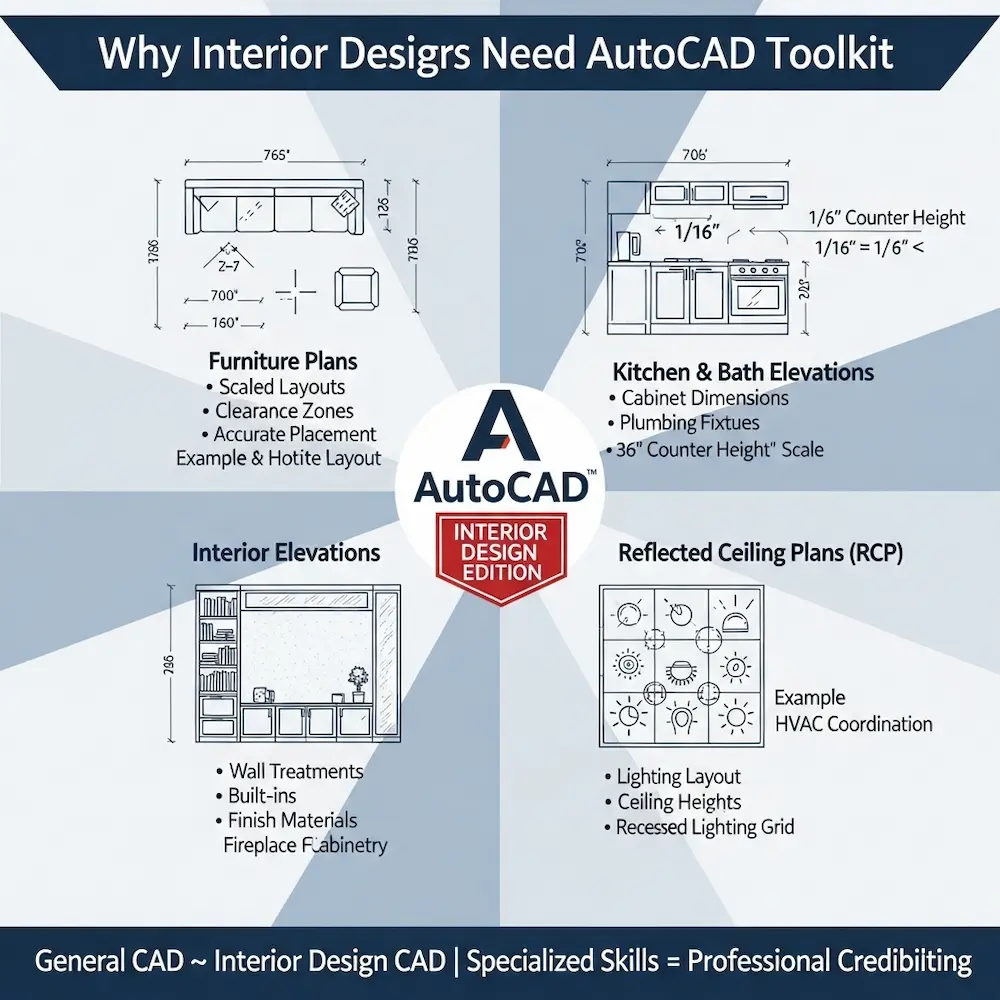
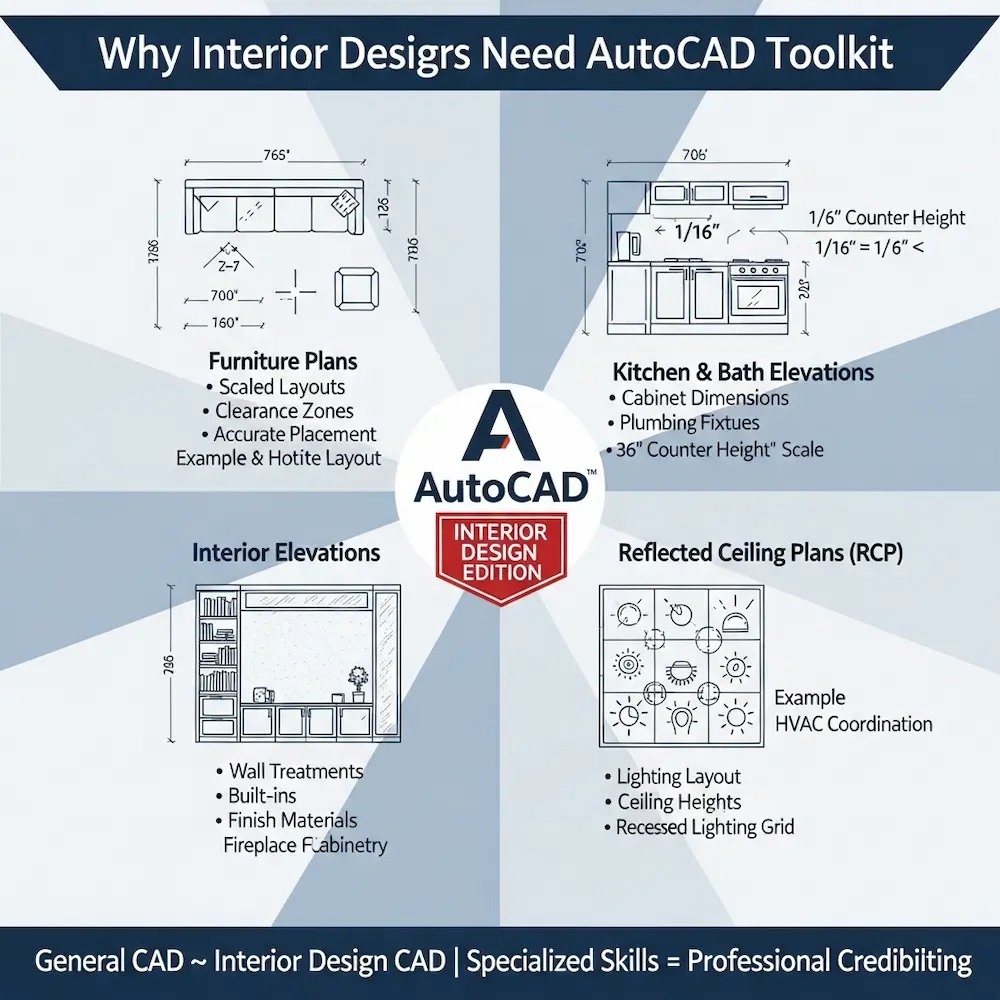
Interior-Specific Drawing Types
Furniture plans and layouts: Unlike architectural plans showing structural elements, interior designers create detailed furniture layouts showing every piece of furniture at accurate scale with proper clearances. CAD Training Online’s “hotel suite layout project” focuses specifically on this interior design application.
Kitchen and bath design: These specialized spaces demand extreme precision—cabinet dimensions to the 1/16 inch, plumbing fixture locations, electrical outlet placement, and appliance specifications. VDCI’s curriculum explicitly includes “Kitchen & Bath Design: Develop precise layouts for kitchens and bathrooms”.
Interior elevations: While architectural elevations show building exteriors, interior elevations depict wall treatments, built-in cabinetry, lighting fixtures, and finish materials room-by-room. Interior Design Den’s course teaches creating “elevations” as core skill for communicating wall designs to contractors.
Reflected ceiling plans (RCPs): These specialized drawings show ceiling treatments, light fixture locations, and ceiling heights—critical for lighting design but rarely covered in general CAD courses.
Top Online AutoCAD Classes Specifically for Interior Design
Several programs tailor AutoCAD instruction to interior design workflows and project types.
Virtual Design and Construction Institute (VDCI)
Program overview: “AutoCAD for Interior Design Course Online” is described as “hands-on” training teaching “essential AutoCAD tools to transform both residential and commercial interior spaces”.
Course structure:
- Duration: 30 hours of project-based training
- Content: 82 training videos
- Instructor: Licensed Architect
- Certification: Verified digital certificate of completion + 3 CEUs
- Cost: $579 (full tuition)
- Residential Design: Create detailed floor plans and elevations for real-world residential remodel
- Kitchen & Bath Design: Develop precise layouts
- Commercial Layouts: Design effective egress plans and furnishings layouts
- Interior Elevations: Produce detailed elevations to showcase designs
- AutoCAD Techniques: Master tools specific to interior design
Unique advantages: Course includes AutoCAD software access, meaning you don’t need to purchase the expensive software separately (Autodesk subscriptions cost $200+/month). The project-based approach ensures you build portfolio-quality work, not just complete abstract exercises.
Format: “100% Online. Start Anytime” with “24/7 access to our premium course videos and projects” and instructor support via messaging.
CAD Training Online
Program focus: Offers both AutoCAD and Revit interior design courses with emphasis on practical application.
AutoCAD interior design course: Structured around “hotel suite layout project where students will learn how to practically apply their AutoCAD skills”. This commercial project teaches skills applicable to both commercial and residential work.
Revit alternative: Their “Revit interior design training focuses on a commercial project and is our most popular class”. Revit’s Building Information Modeling (BIM) approach increasingly dominates professional practice, making this alternative worth considering.
Learning formats: “Students can choose between instructor-led and self-paced courses that best reflect their learning style”. Instructor-led options provide real-time guidance and feedback; self-paced suits busy schedules.
Accreditation: “Our training courses are IDCEC, AIA and CES registered”. This professional recognition matters—you can earn continuing education credits qualifying for professional development requirements.
Target audience: “Both emerging interior designers and experienced professionals” benefit from courses teaching “cutting-edge software that makes designing more efficient”.
Interior Design Den
Specialized focus: “AutoCAD 2D Drafting Course for Interior Designers” is explicitly “a step-by-step self-paced online course teaching how to 2d draft using AutoCAD”.
Designer-to-designer approach: The course description emphasizes “This isn’t your typical technical CAD class. This is a designer-to-designer step-by-step course built just for you”. The instructor understands interior design workflows, not just software commands.
- Clear, repeatable workflow for drafting all interior design plans—from layouts to elevations
- Confidence using AutoCAD for real-world interior projects
- Clarity in drawings so contractors, trades, and clients understand your vision
- Complete interior drawing set for portfolio or client submission
- Time-saving strategies and templates that streamline processes
- Pro-level communication skills for presenting and executing designs
Curriculum structure (7 categories):
- Getting AutoCAD installed & ready
2-3. Learning tools interior designers actually use (focused approach avoiding overwhelming beginners) - Plotting, Viewports & Titleblocks (preparing drawings for printing)
5-6. Layers, Xrefs, Blocks, and Annotations (organization and reusability) - Final Workshop—portfolio-ready drawing package
Cost: $397 (regularly $1,299). Includes lifetime access, self-paced enrollment, downloadable templates and titleblocks, designer-ready furniture blocks, and future updates.
Bonuses: Designer-ready furniture blocks (AutoCAD symbols for floor plans), real project elevations as examples, workflow PDFs with checklists and templates.
Interior Design Online (Australia)
Program: “AutoCAD and Interior Construction” course “tailored specifically for those working in the design and construction industries looking to upskill”.
Project focus: “Develop a drawing package for a residential renovation project including plans, elevations, sections and joinery details”. The emphasis on joinery (cabinetry and built-ins) reflects interior design specialization.
Time commitment: “3 hrs per week / 6 months”. This extended timeline suits working professionals unable to dedicate intensive study periods.
Accreditation: Listed as “Accredited online short course”, providing recognized credentials for Australian design industry.
National Design Academy (UK)
Integrated approach: “Online Interior Design Software Course” teaches not just AutoCAD but also SketchUp and 3D Rendering. This integrated approach acknowledges that professional designers use multiple tools.
Software access: “As an NDA Student you will gain free access to AutoCAD software for 1 year”. Like VDCI, this eliminates the software cost barrier (Autodesk subscriptions are expensive).
Comprehensive toolkit: Learning AutoCAD 2D alongside SketchUp (for 3D modeling) and rendering provides complete technical skillset. You can draft precise plans in AutoCAD, create 3D visualizations in SketchUp, and render photorealistic images for client presentations.
Free and Low-Cost AutoCAD Learning Resources
For budget-conscious designers or those testing AutoCAD interest before investing in specialized courses, free options exist.
Cursa: Free AutoCAD for Beginners
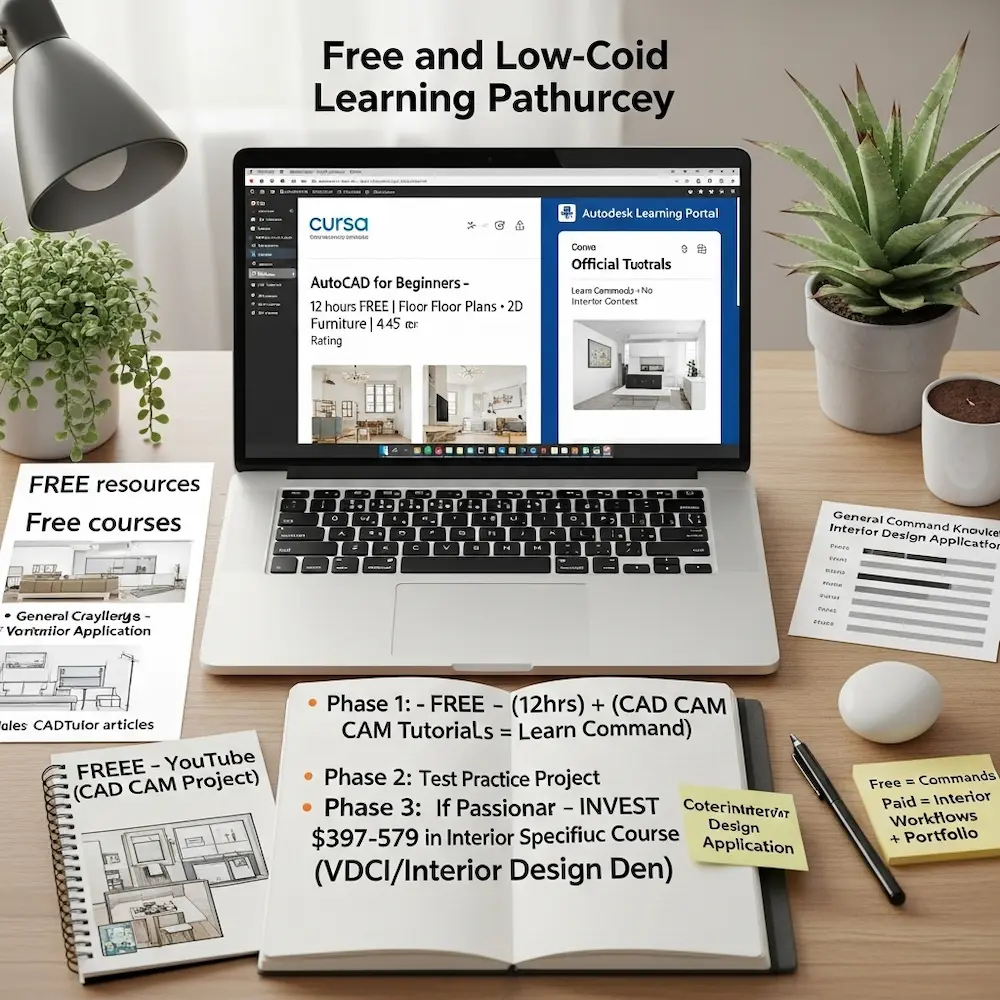
Course overview: “AutoCAD for beginners” is described as “comprehensive free course” that’s “Perfect for beginners in architectural, interior, and engineering design”.
Interior design applications: The course includes “creating simple floor plans and interior design elements” and “guides learners through the steps involved in designing a basic floor plan and furnishing it with 2D furniture drawings”. These specific interior applications distinguish it from pure mechanical drafting courses.
Learning progression: Starts with fundamentals then advances to specialized topics, “ensuring that students can see the relevance and practicality of their newly acquired skills”.
Limitations: Free courses typically lack personalized feedback, advanced interior-specific techniques, and portfolio development guidance that paid courses provide. Use free resources for initial exploration, then invest in specialized training like VDCI or Interior Design Den for professional competence.
Autodesk Learning Portal
Official resources: Autodesk maintains extensive “learning catalog” with tutorials, videos, and documentation. As the software creator, Autodesk provides authoritative instruction.
Self-directed learning: Browse “quick tutorials to certification preparation courses” based on your needs. However, general Autodesk resources don’t provide interior design context—you learn commands abstractly without understanding interior design applications.
Combination strategy: Use free Autodesk tutorials to learn basic commands, then enroll in interior-specific courses like Interior Design Den to understand applying those commands to furniture plans, elevations, and interior documentation.
AutoCAD 2D vs. 3D Tools: What Interior Designers Actually Need
Understanding which AutoCAD capabilities matter most for interior design prevents wasting time on irrelevant features.
2D Drafting: The Foundation
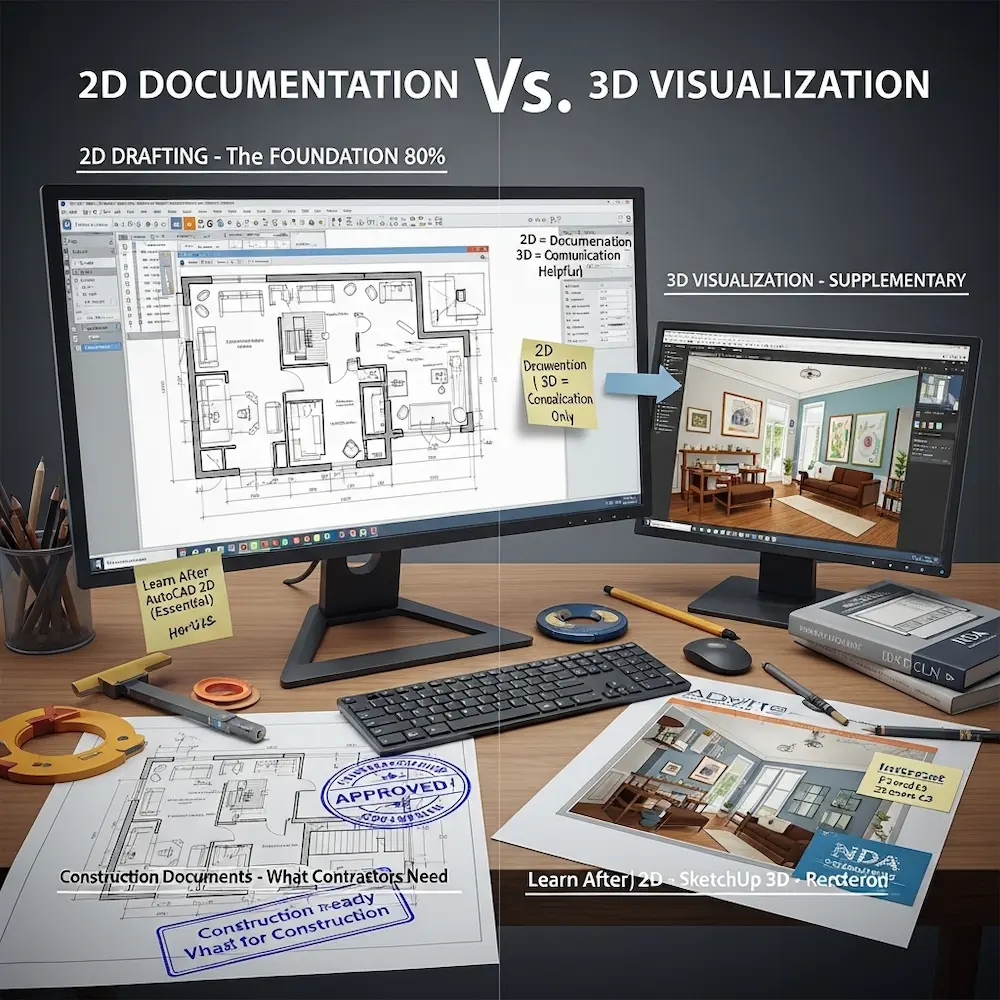
Why 2D dominates interior work: Most interior design documentation—floor plans, furniture layouts, elevations, reflected ceiling plans—uses 2D drafting. Contractors need dimensioned 2D drawings for construction, not 3D models.
Interior Design Den’s focus: Their course explicitly focuses on “AutoCAD 2D Drafting” because “Turn your design vision into precise document drawings using 2d geometry” represents core professional need.
- Drawing and modifying basic geometry (lines, rectangles, circles, arcs)
- Layer management for organizing different drawing elements
- Dimensioning with proper styles and precision
- Annotating with text and leaders
- Creating blocks for reusable furniture symbols
- Working with external references (Xrefs) to coordinate with architectural plans
- Plotting/printing to scale
When 3D Becomes Valuable
Visualization, not documentation: 3D AutoCAD models help you visualize spatial relationships and design intent but don’t replace 2D construction documents. Interior Design Den notes contractors need “clarity in your drawings” through traditional 2D plans and elevations.
Alternative 3D tools: Most designers use SketchUp, Revit, or dedicated rendering software for 3D work rather than AutoCAD 3D. NDA’s integrated course teaching “AutoCAD 2D, SketchUp and 3D Rendering” reflects this workflow—AutoCAD for technical drawings, SketchUp for 3D modeling.
Revit consideration: CAD Training Online notes “Revit interior design training” is their “most popular class”. Revit’s BIM approach offers advantages for large commercial projects and coordination with architects. However, AutoCAD 2D remains essential foundation—learn AutoCAD first, add Revit later if career path demands it.
Curriculum Deep Dive: What You’ll Actually Learn
Understanding course content helps evaluate whether programs teach skills you need.
Residential Interior Projects
Floor plans: Creating accurate residential floor plans with furniture layouts, dimension annotations, door swings, and room labels. VDCI teaches creating “detailed floor plans and elevations for a real-world residential remodel”.
Kitchen design: Precise cabinet layouts, appliance placement, countertop dimensions, and plumbing/electrical locations. Kitchens demand extreme accuracy—1/8 inch errors create expensive construction problems.
Bathroom design: Fixture placement, tile patterns, vanity details, and accessibility clearances. Like kitchens, bathrooms require precision drafting.
Interior elevations: Showing wall treatments, built-in cabinetry, window treatments, and finish materials. Interior Design Den’s final workshop produces “portfolio-ready drawing package” including elevations.
Commercial Interior Applications
Space planning: Furniture layouts for offices, retail stores, restaurants, or hotels optimizing circulation, function, and code compliance. CAD Training Online’s hotel suite project teaches commercial space planning.
Egress plans: Life safety and code compliance require proper exit routes and door sizing in commercial spaces. VDCI’s curriculum explicitly includes “effective egress plans”.
Construction documentation: Producing complete drawing sets contractors use for bidding and construction. Interior Design Online’s course develops “drawing package for a residential renovation project including plans, elevations, sections and joinery details”.
Professional Workflow and Standards
Layer standards: Organizing drawings with proper layer naming and properties so architects and contractors can navigate your files. Interior Design Den teaches “Layers, Xrefs, Blocks, and Annotations” as professional organization tools.
Titleblocks and plotting: Setting up professional drawing sheets with title blocks, scale indicators, and proper plotting for printing or PDF creation. “Plotting, Viewports & Titleblocks” represents essential Category 4 in Interior Design Den’s curriculum.
Template development: Creating custom templates with pre-loaded layers, dimension styles, text styles, and titleblocks accelerates future projects. Templates represent “time-saving strategies” Interior Design Den emphasizes.
Integration with Interior Design Principles
AutoCAD isn’t standalone—it integrates with broader design knowledge.
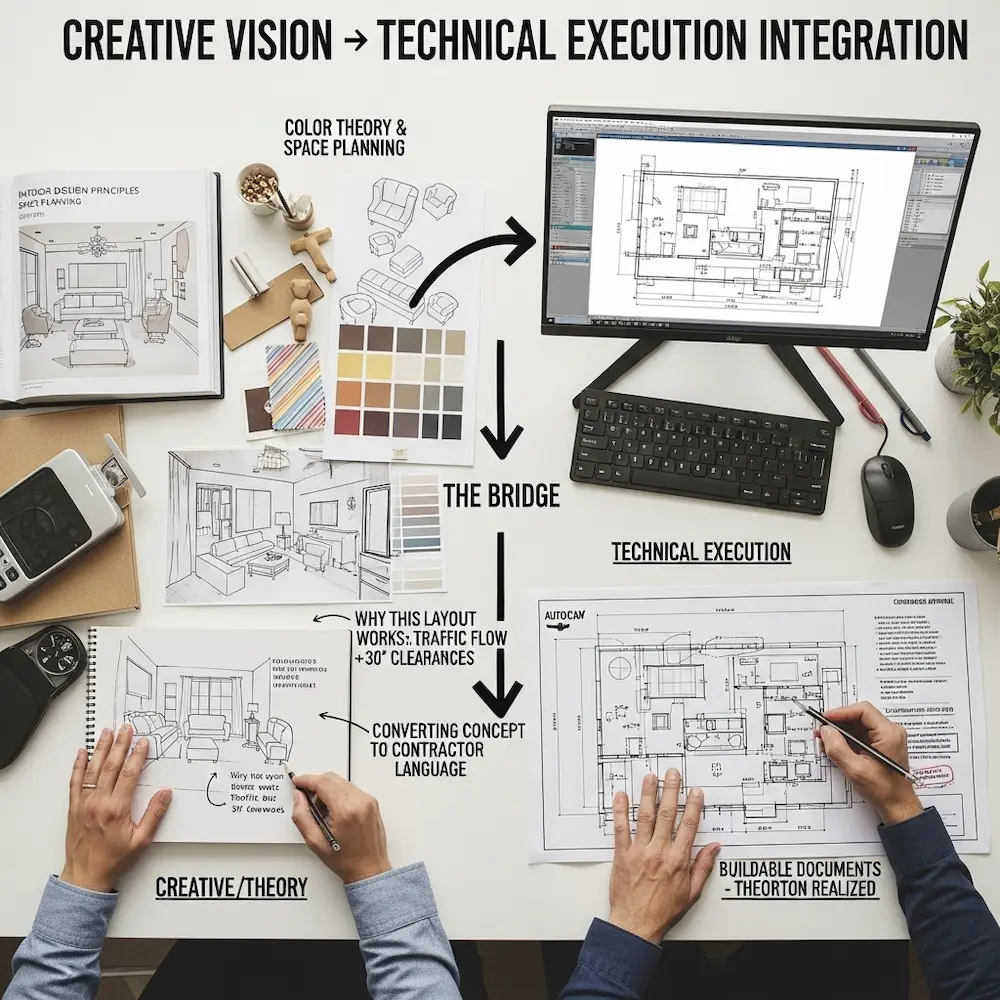
Technical Skills Supporting Creative Vision
From concept to construction: Your interior design principles class online taught color theory, space planning theory, and furniture arrangement. AutoCAD transforms that theoretical knowledge into actionable construction documents contractors execute.
Design communication: VDCI emphasizes learning to “effectively communicate your designs” through technical drawings. Beautiful design ideas fail if you can’t communicate them clearly to builders.
Curriculum Coordination
Parallel learning paths: Many students benefit from studying design principles and technical drafting simultaneously. Understanding why certain furniture arrangements work (from principles courses) while learning how to document those arrangements precisely (from AutoCAD courses) creates comprehensive competence.
Sequential approach: Alternatively, complete fundamental interior design education first (like programs covered in our guide to accredited online interior design classes), then add AutoCAD as technical skill. This sequence ensures you understand what to draw before learning how to draw it technically.
Conclusion
Mastering online AutoCAD classes interior design transforms interior designers from concept creators into technical professionals who control entire project lifecycles from inspiration through construction. Specialized programs like Virtual Design and Construction Institute’s 30-hour course teaching kitchen design, elevations, and commercial layouts, CAD Training Online’s hotel suite project emphasizing practical application, and Interior Design Den’s designer-focused workflow training provide interior-specific instruction that general CAD courses can’t match. My inability to provide construction documents to that contractor wasn’t a permanent limitation—it was a skill gap I filled through focused AutoCAD training tailored to interior design applications. Within three months of completing an interior-specific AutoCAD course, I could produce professional drawing sets, confidently coordinate with contractors, and command higher fees because clients recognized my technical competence alongside creative vision.
The investment in specialized AutoCAD training—whether VDCI’s $579 comprehensive course, Interior Design Den’s $397 designer-focused program, or even starting with free resources like Cursa before advancing to paid instruction—pays dividends throughout your design career by enabling you to execute projects independently, communicate precisely with construction professionals, and build portfolios demonstrating both creative and technical mastery. For context on how AutoCAD fits within comprehensive interior design education, return to our ultimate guide to interior design classes online. To understand which credentials support professional practice, explore our guide to accredited online interior design classes. And for budget-conscious learners, our guide to interior design classes online free shows how to begin skill-building without financial investment before advancing to specialized technical training.


