

Best Online Graphic Design Colleges 2026: Complete Guide to Degrees and Certificates
Table of Contents
The email notification sat in my inbox for three days before I had the courage to open it. “Congratulations on your acceptance to the graphic design program”. After years working retail while sketching logo concepts in stolen moments during lunch breaks, I was finally starting my formal design education—entirely online. No commute to campus, no rigid class schedules conflicting with my work shifts, just me, my laptop, and instructors from one of the nation’s top design schools teaching via video lectures and live critiques. That decision to pursue online graphic design education changed everything. Within two years, I had built a portfolio strong enough to land freelance clients, and six months after graduation, I transitioned to full-time design work. But the path wasn’t obvious at the beginning. Should I pursue a full bachelor’s degree or start with a certificate program from a community college? Did the school’s reputation matter for online programs, or were they all essentially the same? How could I afford tuition while working full-time? Choosing from hundreds of online graphic design colleges requires understanding the landscape of options—from affordable community college certificates providing foundational skills to prestigious four-year institutions offering comprehensive bachelor’s degrees with industry connections.
Online graphic design colleges have evolved dramatically from their early correspondence-course origins into sophisticated programs rivaling traditional on-campus education. Today’s top online programs deliver the same rigorous curriculum, experienced faculty, and portfolio-building projects as their brick-and-mortar counterparts, but with flexibility enabling students to balance education with work, family, and other responsibilities. The landscape spans affordable community college certificate programs costing a few thousand dollars and preparing students for entry-level positions or transfer to four-year institutions, comprehensive bachelor’s degree programs from accredited universities providing professional credentials and deep technical training, and specialized master’s programs for career advancement. BestColleges’ 2025 rankings highlight schools like Arizona State University, Southern New Hampshire University, and Full Sail University leading the online graphic design education space. Meanwhile, prestigious institutions like Savannah College of Art and Design (SCAD) have built comprehensive online offerings maintaining their reputation for excellence. Understanding this ecosystem—the differences between degree levels, the role of accreditation, geographic considerations even for online programs, and cost structures—empowers prospective students to make informed decisions aligning educational investment with career goals.
This comprehensive directory explores online graphic design colleges across all categories, covering top-tier bachelor’s degree programs from nationally recognized institutions, affordable community college certificate options providing foundational training, specialized programs with strong regional connections in Texas, Florida, North Carolina, and beyond, key evaluation criteria including accreditation, cost, and career outcomes, and practical guidance for application and success in online learning environments. Whether you’re a high school graduate seeking your first degree, a working professional looking to transition into design, or someone exploring creative education options, this guide provides the roadmap for navigating online graphic design education in 2025.
Understanding the Online Graphic Design Education Landscape
Before diving into specific schools, understanding the structure of online graphic design education clarifies your options.
Degree Levels and Program Types
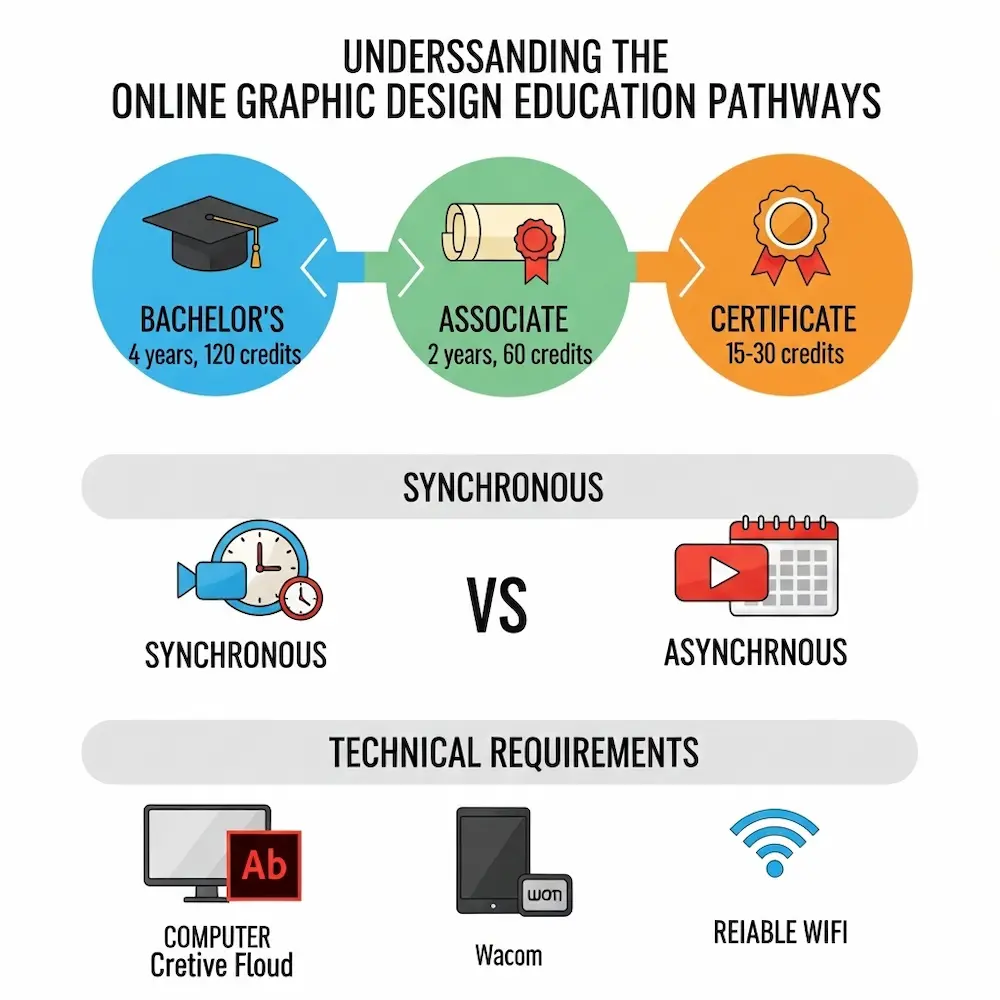
Bachelor’s degrees represent comprehensive four-year programs (typically 120-126 credits) providing thorough grounding in design principles, technical skills, art history, and professional practices. Arizona State University’s online program, ranked among the best by BestColleges, requires 120 credits covering “visual communication, graphic design history, graphic design principles, motion graphics, and more”. These programs prepare graduates for professional designer roles and often include concentrations in UX design, motion graphics, or branding.
Associate degrees from community colleges typically require 60-64 credits over two years. These programs provide foundational design skills and general education courses, preparing students for entry-level positions or transfer to bachelor’s programs. Hudson County Community College’s Digital Art and Design Certificate explains: “Students completing the Certificate will be able to apply the credits earned towards the A.F.A. Studio Arts, Computer Art Option at HCCC or use the skills learned to advance their career prospects”.
Certificate programs range from a few courses to 30+ credits, focusing specifically on design software and core skills without the general education requirements of degree programs. The International Association of Professions Career College offers a fully online Graphic Designer Certificate Course providing “lifetime access to course materials” and downloadable credentials upon completion. These programs suit professionals seeking specific skills or career changers testing the waters before committing to full degrees.
The Online Learning Experience
Synchronous vs. asynchronous formats define how online courses operate. Synchronous classes meet at scheduled times via video conferencing, providing real-time interaction with instructors and peers. Asynchronous courses allow students to complete work on their own schedules, with recorded lectures and assignment deadlines but no required meeting times. Most online graphic design programs use hybrid models—asynchronous lectures with scheduled critique sessions or project reviews.
Technical requirements include reliable internet, computers capable of running professional design software (Adobe Creative Cloud, typically), and often digital drawing tablets. SCAD’s online program notes students work with “the latest design software and technologies” and complete “practical, hands-on projects”. Quality online programs provide software licenses or significant discounts.
Top-Tier Online Graphic Design Degree Programs
Several institutions stand out for their comprehensive online bachelor’s programs combining academic rigor, industry connections, and flexible delivery.
Arizona State University (ASU Online)
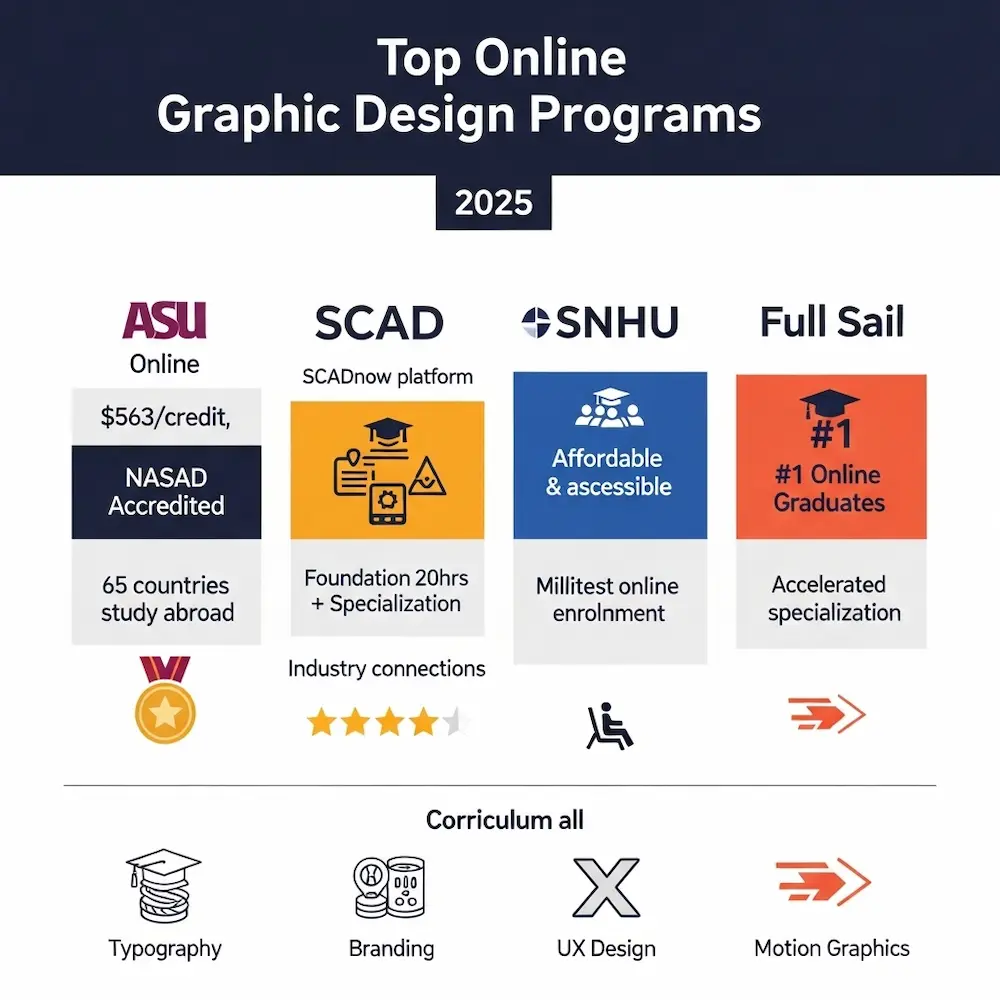
Program overview: ASU Online’s graphic design program earns recognition from BestColleges as a top online option for 2025. The school boasts “over 300 undergrad and graduate programs” and “celebrated graduating 100,000 students in April 2024”. The graphic design curriculum covers comprehensive foundations including visual communication, design history, and motion graphics.
Unique advantages: ASU Online students access study abroad opportunities “in over 65 countries” despite studying online, and participate in “a digital community with 18 clubs just for online students”. This combination of flexibility and community distinguishes ASU from purely distance programs. TheBestSchools.org lists ASU’s cost at “$563 per credit” (same rate for in-state and out-of-state students), totaling approximately $67,560 for the 120-credit degree.
Accreditation: The program holds accreditation from the National Association of Schools of Art and Design (NASAD), the specialized accrediting body for art and design programs. This distinction matters for professional credibility and potential graduate school admission.
Savannah College of Art and Design (SCAD)
Reputation and offerings: SCAD consistently ranks among the nation’s top design schools. ScholarsHub’s 2025 rankings list SCAD alongside Rhode Island School of Design (RISD), Yale, and ArtCenter as “top graphic design institutions”. The school offers its B.A. in Graphic Design “online as part of our award-winning SCADnow program”.
Curriculum depth: SCAD’s program includes “courses in digital communication, typography, branding, and UX design” with “emphasis on practical, hands-on projects”. The curriculum requires foundation studies (20 hours) covering drawing, design elements, and color theory before advancing to specialized graphic design coursework. This thorough grounding distinguishes SCAD from programs rushing students into software training without conceptual foundations.
Industry connections: SCAD maintains relationships with major design employers and hosts annual career fairs attracting hundreds of companies. For online students, these connections translate to networking opportunities and portfolio reviews with industry professionals.
Southern New Hampshire University (SNHU Online)
Scale and accessibility: SNHU Online represents one of the largest online universities, with OnlineU.com noting it ranks prominently for online graphic design graduates. BestColleges includes SNHU in its 2025 top programs list.
Affordability focus: SNHU emphasizes accessible education with multiple scholarship opportunities and military benefits. While specific per-credit costs vary, SNHU’s model targets working adults seeking affordable, flexible pathways to degrees.
Full Sail University
Specialized creative focus: Full Sail ranks “#1 overall with 374 graduates from its online bachelor’s in graphic design” according to OnlineU.com. Unlike traditional universities offering dozens of majors, Full Sail specializes entirely in creative and technology fields, bringing focused expertise to design education.
Accelerated format: Full Sail’s programs often use accelerated schedules, enabling completion faster than traditional four-year timelines. This appeals to career changers and motivated students seeking quicker entry to the workforce.
Additional Notable Programs
Lesley University in Cambridge, MA holds NASAD accreditation and charges “$495 per credit” for its 123-credit program. Kentucky Wesleyan College appears on BestColleges’ rankings. Our cluster article exploring top online colleges for graphic design degrees examines these and additional programs in comprehensive detail.
The Community College Path: Affordable Certificates and Associate Degrees
For students seeking lower-cost entry points, shorter timelines, or exploration before committing to bachelor’s programs, online graphic design community colleges provide valuable options.
Benefits of the Community College Route
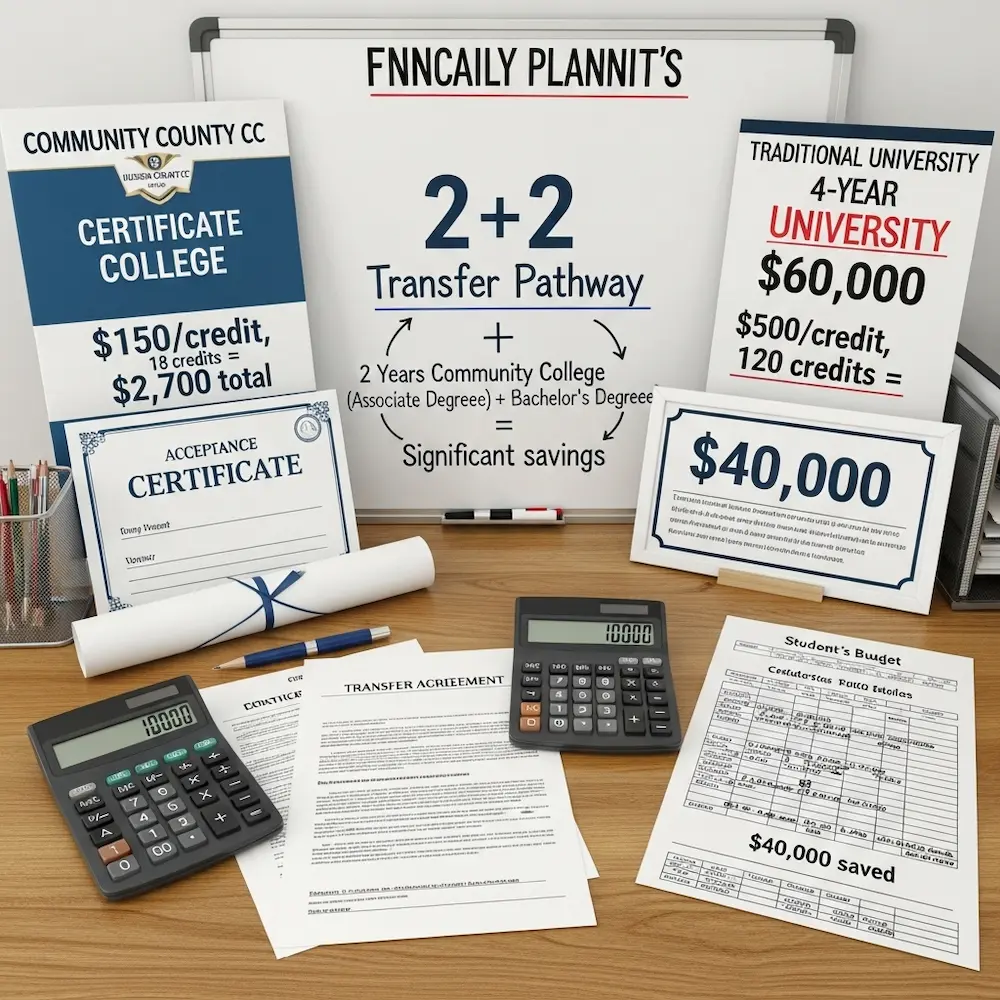
Cost savings: Community colleges typically charge $100-200 per credit versus $400-600+ at four-year institutions. An associate degree or certificate costing $3,000-8,000 versus $40,000-80,000 for a bachelor’s makes community colleges the cheapest online college for graphic design education.
Transfer pathways: Many community college programs explicitly design curricula to transfer to four-year institutions. Students complete foundational coursework affordably, then transfer with junior standing to complete bachelor’s degrees. This “2+2” model saves significant money while achieving the same final credential.
Career exploration: Certificate programs requiring just 15-30 credits allow students to test design education before committing years and tens of thousands of dollars. If design proves a poor fit, minimal investment is lost; if passion is confirmed, certificates often apply toward degree programs.
Certificate vs. Associate Degree Programs
Certificate programs focus exclusively on design skills—software proficiency, design principles, typography, color theory—without general education requirements. Hudson County Community College’s Digital Art and Design Certificate “will prepare students for continued study and professional work in various areas of computer-based art and design including graphic design, web design, digital video and animation”. These programs suit working professionals adding skills or career changers seeking quick entry.
Associate degrees include general education (English, math, humanities) alongside design coursework, providing more rounded education and stronger transfer standing. The Hudson County program notes students can “apply the credits earned towards the A.F.A. Studio Arts, Computer Art Option”. Associate degrees better position students for bachelor’s degree transfer, while certificates emphasize immediate skill application.
Geographic Community College Options
While online programs transcend geography, community colleges often maintain strong regional connections and recognition. Our dedicated cluster article on online graphic design community college explores specific institutions including Moorpark College’s certificate program in California, Greensboro NC Community College’s offerings, Saddleback College in California, and community colleges in South Carolina, Texas, and Florida offering online options. Understanding regional nuances helps students choose programs aligned with local job markets.
Regional Considerations: State-Specific Online Programs
Even for fully online programs, geographic factors matter—tuition rates, regional accreditation, transfer agreements, and job market connections.
Why Location Matters for Online Programs
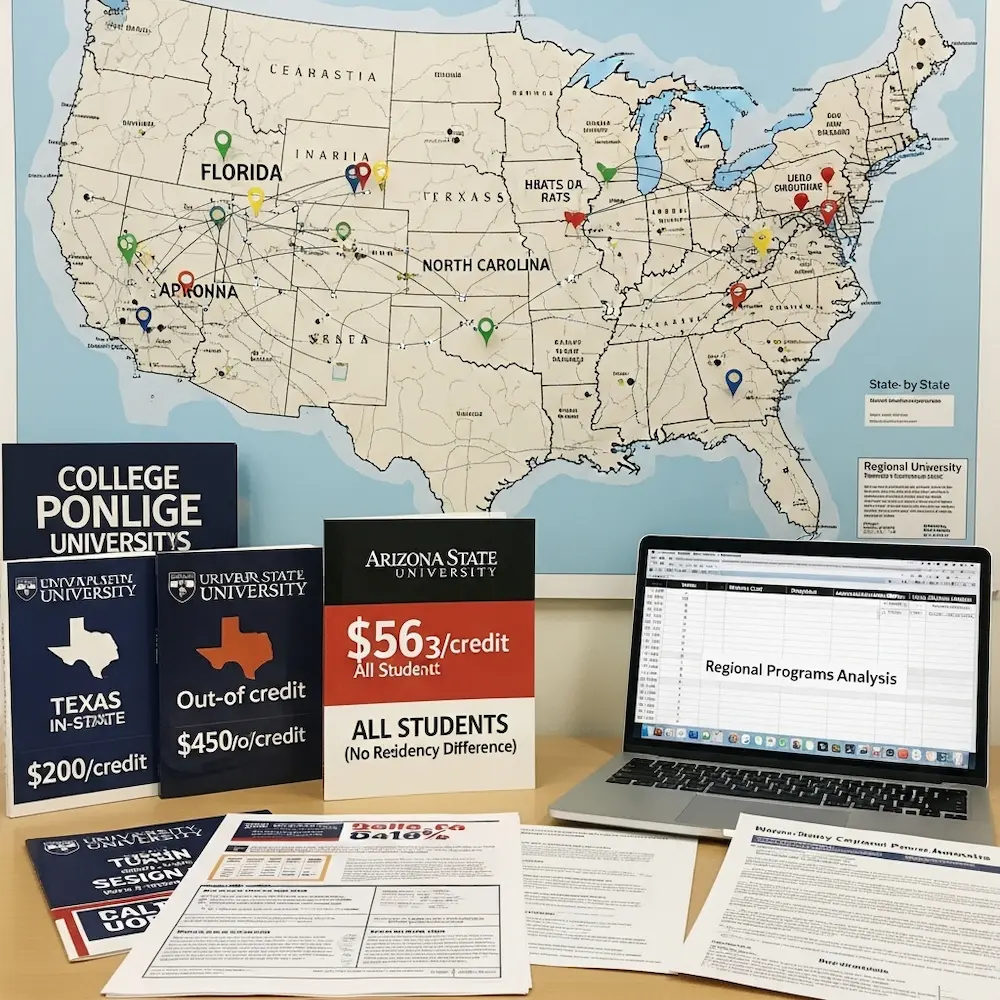
In-state tuition rates: Many public universities offer lower tuition for state residents even in online programs. Arizona State University charges the same rate regardless of residency (“$563 per credit” for all), but not all schools follow this model. Florida, Texas, and North Carolina residents may access special in-state online rates at public institutions.
Regional accreditation and licensing: Certain states require specific accreditation for professional licensing or certification. While graphic design rarely requires licensure, related fields (like teaching) may have state-specific requirements.
Local job market connections: Colleges with physical campuses in your state may maintain relationships with local employers, even for online students. A Texas-based college likely has stronger Dallas or Houston design industry connections than an East Coast school.
Major State Highlights
Florida boasts numerous online options from both community colleges and universities. Prospective students should explore florida online graphic design colleges including state university system offerings and private institutions.
Texas students can access online programs from Texas state universities and community colleges, with our geographic cluster article detailing options for finding the right online college for graphic design for texas residents.
North Carolina features strong community college systems with online graphic design programs serving the Research Triangle’s growing tech design sector.
Minnesota, Iowa, Wisconsin, and other Midwest states offer regional programs balancing affordability with quality. Our cluster article exploring online graphic design colleges by state provides comprehensive state-by-state breakdowns.
Key Factors to Evaluate When Choosing Online Programs
With hundreds of options, systematic evaluation criteria help narrow choices.
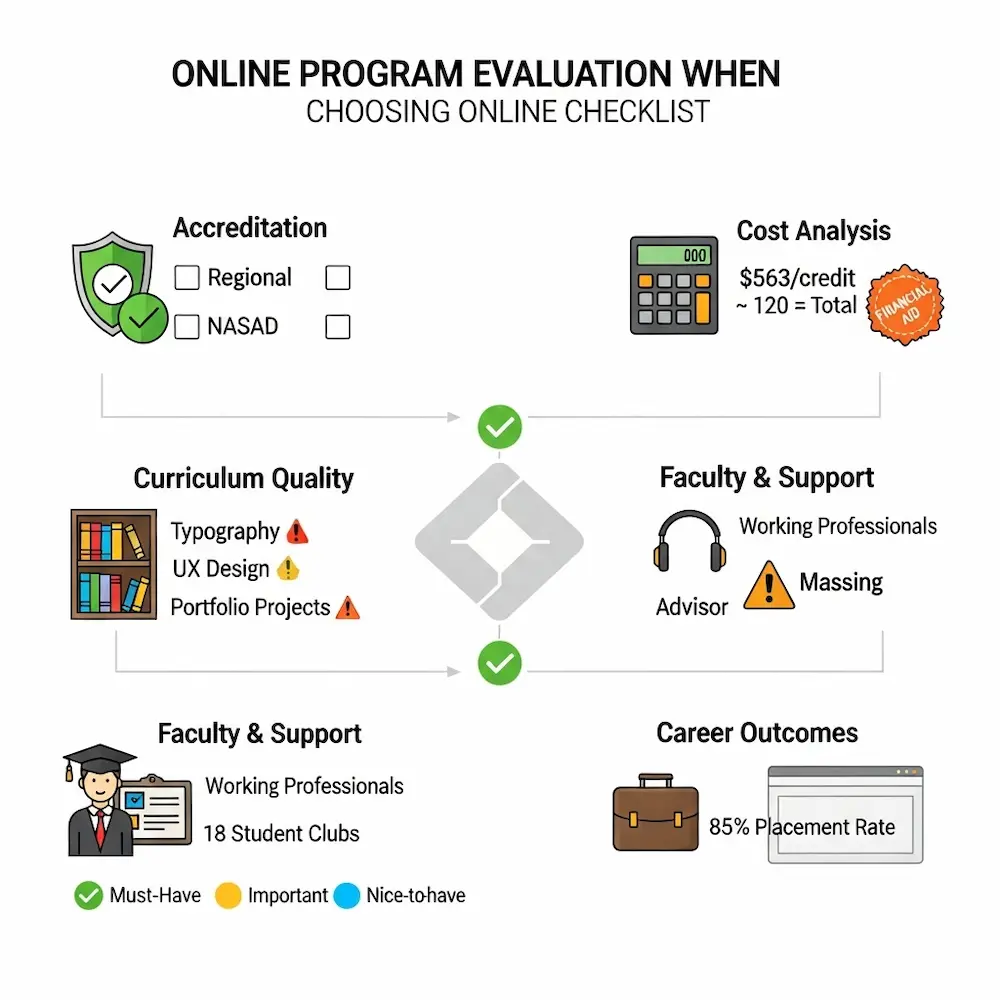
Accreditation: The Non-Negotiable Foundation
Institutional accreditation from regional accrediting bodies (like SACSCOC for Southern schools) ensures baseline academic quality and federal financial aid eligibility. SCAD holds accreditation from “the Southern Association of Colleges and Schools Commission on Colleges (SACSCOC)”.
Programmatic accreditation from the National Association of Schools of Art and Design (NASAD) represents the gold standard for design programs. BestSchools.org’s rankings explicitly note NASAD accreditation for ASU and Lesley University. While not all quality programs hold NASAD accreditation, it signals rigorous standards and industry recognition.
Cost and Financial Aid
Total program cost varies dramatically—from a few thousand dollars for community college certificates to $80,000+ for bachelor’s degrees at private institutions. Calculate total cost by multiplying credit hours required by per-credit tuition rate. Arizona State at “$563 per credit” for 120 credits totals $67,560. Don’t forget fees, software costs, and equipment.
Financial aid availability: Accredited programs qualify for federal student aid (loans, grants). Many schools offer institutional scholarships specifically for online students. Military members and veterans should investigate GI Bill benefits and Yellow Ribbon programs.
Curriculum and Specializations
Core curriculum quality: Strong programs balance software training with conceptual design education. SCAD’s curriculum including “typography, branding, and UX design” alongside “practical, hands-on projects” exemplifies comprehensive approaches. Programs emphasizing only software tutorials without design theory produce technicians, not designers.
Specialization options: Modern graphic design encompasses diverse specialties—UX/UI design, motion graphics, branding, packaging, web design. Programs offering concentrations or elective tracks enable students to develop focused expertise matching career interests.
Faculty and Student Support
Instructor credentials: Quality programs employ working professionals and experienced educators, not just adjuncts teaching software. Review faculty pages assessing instructors’ portfolios and industry experience.
Support services: Online students need robust technical support, academic advising, and career services. ASU Online’s “digital community with 18 clubs just for online students” shows commitment to online student experience beyond just content delivery.
Career Outcomes and Portfolio Development
Employment rates and graduate outcomes: Research programs’ job placement rates and where graduates work. Schools highlighting employer partnerships and career services infrastructure demonstrate commitment to student success beyond graduation.
Portfolio requirements: Professional design careers require strong portfolios. Programs structuring curricula around portfolio-building projects, offering portfolio reviews, and providing portfolio hosting prepare students for job searches.
Making Your Decision: Degree vs. Certificate, University vs. Community College
Different educational paths suit different circumstances.
When to Choose Bachelor’s Degree Programs
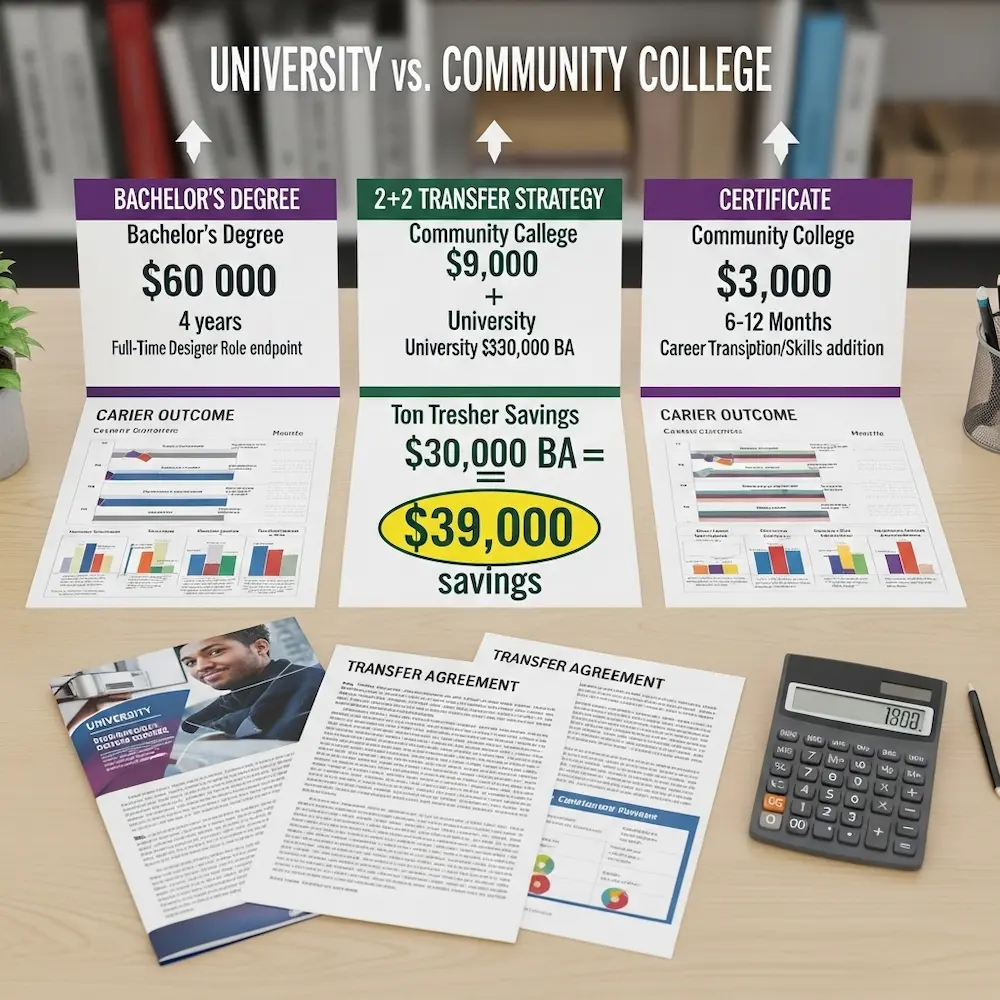
Career goals: Professional designer positions at agencies, corporations, and design studios typically require bachelor’s degrees. If your goal is full-time design employment, four-year programs provide necessary credentials.
No prior college credits: High school graduates or those without college experience benefit from comprehensive degree programs including general education. Bachelor’s degrees provide well-rounded education beyond design skills.
Investment capacity: If you can invest 3-4 years and $40,000-80,000 in education, bachelor’s degrees offer thorough training and strong credentials.
When Community College Certificates Make Sense
Career transition: Working professionals in other fields seeking design skills benefit from focused certificate programs. A marketing professional adding design capabilities or a photographer learning layout doesn’t need a full degree.
Budget constraints: If affordability is paramount, community college certificates provide legitimate credentials at fraction of degree costs. These function as stepping stones—gaining skills and portfolio pieces while continuing to work.
Testing the waters: Students uncertain about design careers can complete certificates in 6-12 months, building portfolios and gaining experience before committing to bachelor’s programs.
The 2+2 Transfer Strategy
Optimal cost-benefit: Starting at community college for associate degree, then transferring to four-year institution for bachelor’s degree combines affordability with strong credentials. Complete 60 credits at $150/credit ($9,000), then 60 credits at $500/credit ($30,000) for total of $39,000 versus $60,000+ for all 120 credits at the university.
Transfer agreements: Research articulation agreements between community colleges and destination universities ensuring smooth credit transfer. Many state systems guarantee admission and junior standing for community college graduates meeting GPA requirements.
Conclusion
Choosing from the diverse landscape of online graphic design colleges requires understanding your goals, constraints, and the options available. From affordable community college certificates providing foundational skills and testing grounds for design passion, through comprehensive bachelor’s degrees from institutions like Arizona State University, SCAD, and Southern New Hampshire University offering professional credentials and deep training, to specialized programs with strong regional connections serving specific geographic markets, online graphic design education in 2025 provides pathways for every student. My journey from retail worker sketching during lunch breaks to professional designer began with carefully researching programs, understanding what I needed versus what I could afford, and choosing an online program matching my circumstances. That educational investment—the knowledge gained, portfolio built, and credential earned—opened doors I couldn’t have accessed otherwise.
The comprehensive coverage here provides overview of online graphic design education’s landscape, but deeper exploration of specific program categories clarifies decisions. For students prioritizing affordability and flexibility, our cluster article on online graphic design community college examines certificate programs, associate degrees, and transfer pathways in detail. For those seeking comprehensive four-year programs, our guide to top online colleges for graphic design degrees compares leading institutions’ curricula, costs, and outcomes. And for students whose location matters—whether for in-state tuition, regional job connections, or state-specific requirements—our article on online graphic design colleges by state breaks down options in Texas, Florida, North Carolina, Minnesota, Iowa, and beyond. Together, these resources empower you to make informed decisions transforming creative passion into professional careers.


