

Online Graphic Design Community College: Affordable Certificates and Transfer Options
Table of Contents
online graphic design community college – Understanding the community college landscape for online graphic design education requires distinguishing between certificate programs, associate degrees, and transfer-focused curricula. Certificate programs like Moorpark College’s 24-unit Certificate of Achievement focus exclusively on design skills—software proficiency, typography, layout, image editing—without general education requirements. These programs typically cost $1,200-$3,000 total depending on per-credit rates and prepare students for entry-level positions or continued education. Associate degrees requiring 60-64 credits include general education alongside design coursework, providing more comprehensive education and stronger positioning for bachelor’s degree transfer. Transfer-specific degrees like the Associate in Arts for Transfer (AA-T) explicitly design curricula to articulate with four-year institutions, particularly within California’s robust community college to CSU/UC transfer system. As explored in our comprehensive directory of online graphic design colleges, community colleges serve as strategic entry points—testing design passion affordably, building foundational portfolios, and establishing transfer pathways to prestigious four-year programs.
This detailed guide explores online graphic design community college options, covering the financial advantages making community colleges the cheapest online college for graphic design education, specific certificate and associate degree program structures, geographic breakdown of regional community college offerings, transfer pathways from community college to four-year institutions, and practical guidance for deciding whether community college classes suit your circumstances. Whether you’re a high school graduate seeking affordable design education, a working professional adding skills through online certificates, or a strategic student planning cost-effective bachelor’s degree completion, this guide provides roadmap for leveraging community college advantages.
The Community College Advantage: Why It’s the Cheapest Option
Financial considerations often determine educational accessibility. Community colleges dramatically lower barriers to entry.

Cost Comparison: Community College vs. University
Per-credit cost differentials create massive total savings. Community colleges typically charge $46-$150 per credit for in-state students versus $400-$800+ per credit at four-year institutions. UMass Lowell’s online certificate program notes “Tuition at UMass Lowell is typically half the cost of private colleges, and our online tuition is among the lowest in the nation”. Even this “affordable” university option costs significantly more than community colleges.
Certificate program total costs: Moorpark College’s 24-unit Certificate of Achievement at California community college rates (~$46/unit for in-state students) totals approximately $1,104. Even out-of-state students paying higher rates (~$200/unit) pay around $4,800. Compare this to Bryan University’s certificate at standard university rates, though Bryan emphasizes “affordable tuition rates for all students, no matter where they reside” and “lock-in your tuition rate when you enroll”. The International Association of Professions Career College offers their certificate for “$149.00 for the December 08, 2025 course” with “lifetime access to course materials,” representing the absolute cheapest online college for graphic design certificate education.
Associate degree cost savings: A 60-credit associate degree at $100/credit average costs $6,000 versus $24,000-$48,000 for equivalent credits at four-year institutions. Students completing associate degrees before transferring to universities save $15,000-$40,000 while achieving identical final bachelor’s degrees.
Financial Aid and Accessibility
Federal financial aid eligibility: Accredited community colleges qualify for Pell Grants and federal student loans. Many community college students receive Pell Grants covering entire tuition, making education essentially free. This transforms graphic design education from impossible luxury to accessible opportunity.
No hidden fees: Unlike universities charging technology fees, activity fees, and facility fees, community colleges keep costs transparent and minimal. The course costs reflect actual education expenses, not campus amenities.
Work-while-learning feasibility: Lower credit loads required for certificate programs (often just 2-3 classes per semester) enable students to maintain employment while studying. This contrasts with intensive university programs expecting full-time student status.
Certificate Programs: Focused Skill Development
Certificate programs provide targeted design education without degree program commitments.

What Community College Certificates Cover
Core design curriculum: Moorpark College’s Certificate of Achievement requires specific courses building comprehensive skills:
- Introduction to Computer Graphics or Introduction to Digital Media (3 units)
- Digital Illustration (3 units)
- Image Editing (3 units)
- Digital Layout or Typography (3 units)
- Design fundamentals (3 units)
- Social Media Design (3 units)
- Design Portfolio (3 units)
- Design Business Practices (3 units)
Total: 24 units creating “well-versed” designers capable of working “in publishing companies, in-house design departments, studios, advertising agencies, and other visual arts occupations”.
Software proficiency: Certificate programs emphasize hands-on software training. Bryan University’s certificate includes “practice throughout your program using Figma and the Adobe Creative Cloud products – all of which are included in tuition at no extra cost”. UMass Lowell’s program features “design courses in photographic imaging, typography, user interface prototyping and advertising design”. These technical skills directly translate to employment.
Portfolio development: Moorpark’s curriculum includes dedicated “Design Portfolio” course (DES M190) teaching students to “demonstrate the skills and knowledge necessary to apply deductive and inductive reasoning to analyze problems and synthesize solutions to design problems”. Portfolio-building integrated throughout programs ensures graduates have work samples for job applications.
Certificate vs. Degree: Making the Choice
Time commitment differences: Certificates requiring 18-30 credits complete in 1-2 semesters full-time or 2-4 semesters part-time. Associate degrees requiring 60+ credits take 2 years full-time or 3-4 years part-time. For working professionals or those testing design interest, certificates offer quicker pathways.
Employment outcomes: Certificate holders qualify for entry-level designer positions, freelance work, and specialized roles emphasizing software proficiency. Associate degree holders have stronger credentials for competitive positions and solid foundation for bachelor’s degree transfer. The Reddit discussion on graphic design certificates notes legitimate programs like “Graduate School USA is an accredited graduate school that offers a Graphic Design Certificate Program”, emphasizing accreditation importance.
Career goal alignment: Choose certificates if you’re adding design skills to existing careers (marketing professional learning layout), testing design passion before degree commitment, or seeking quick entry to freelance work. Choose associate degrees if you plan bachelor’s degree transfer, want comprehensive design education including art history and theory, or need stronger credentials for competitive positions.
Associate Degrees and Transfer Pathways
Community college associate degrees serve dual purposes: standalone credentials and transfer vehicles to four-year institutions.
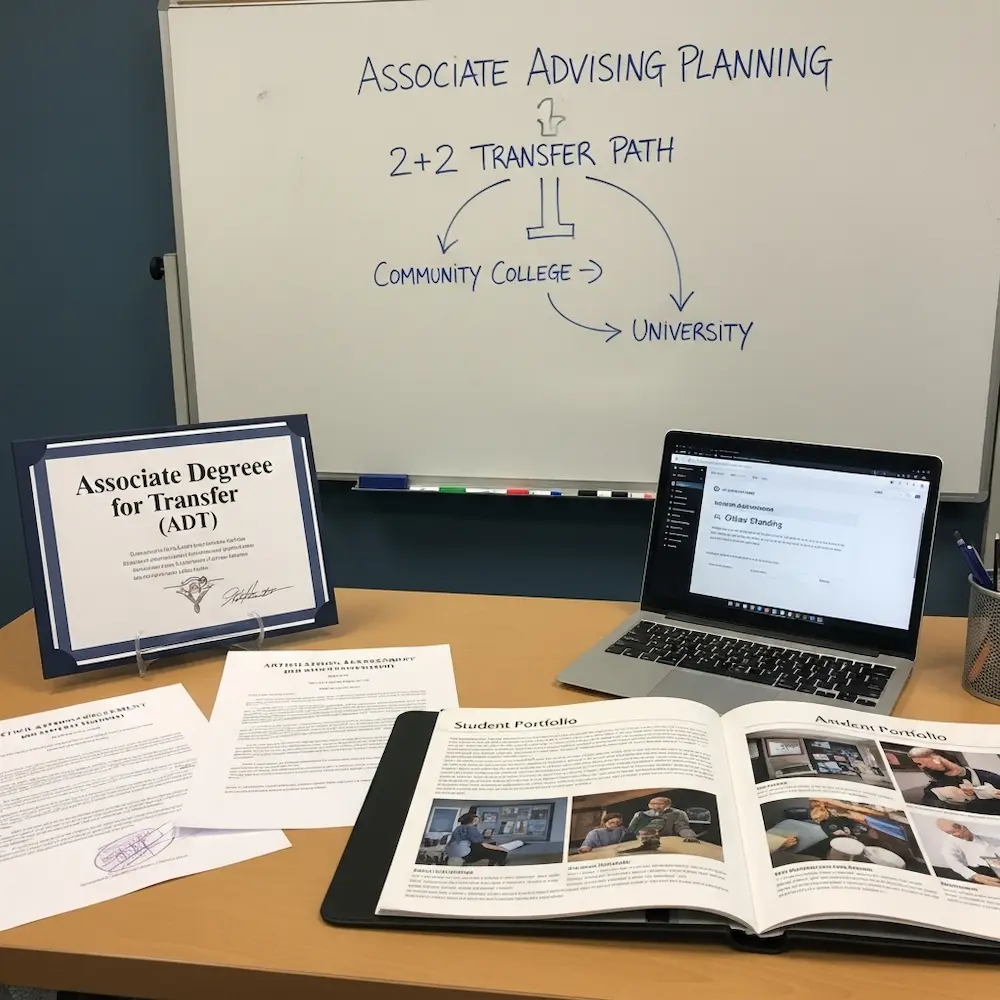
The Associate Degree for Transfer (ADT)
California’s transfer guarantee: California’s community college system offers Associate in Arts for Transfer (AA-T) degrees guaranteeing admission to California State University system. Taft College’s Studio Arts Degree for Transfer explains: “The Associate in Arts in Studio Arts degree for Transfer prepares students to transfer to a four-year institution to further their studies of the practice and production of visual arts”. Students completing AA-T degrees with minimum 2.0 GPA gain “deemed eligible for transfer into a California State University baccalaureate program”.
60-unit structure: Transfer degrees require “completion of a minimum of 60 semester units or 90 quarter units that are eligible for transfer to the California State University”. These units include major preparation (design courses) and general education (English, math, humanities). This structure ensures students complete lower-division requirements before transferring.
Junior standing entry: Students transferring with associate degrees enter universities as juniors, not freshmen. This means two years at affordable community college rates, then two years completing upper-division coursework and specializations at university. Santa Ana College’s transfer prep program notes “Degree Program B is specifically geared for students to transfer to a state university leading to a baccalaureate degree with more intense study of graphic design skills and applications”.
Strategic Transfer Planning
Articulation agreements: Community colleges maintain formal agreements with universities specifying which courses transfer and fulfill requirements. Santa Ana College advises: “Students planning for transfer should be aware that each university has unique degree requirements. Please consult a SAC counselor for information about course requirements for particular four-year institutions”. This counseling ensures smooth transfers.
Course selection strategy: Take transferable courses from the beginning. Some remedial or vocational courses don’t transfer to universities. Working with academic advisors prevents taking non-transferable credits wasting time and money.
Portfolio continuity: Design work created in community college courses becomes portfolio foundation for university applications and later job searches. Quality work matters regardless of where it was created. My community college projects formed half my transfer application portfolio and several pieces from those early classes appeared in my first professional portfolio.
Geographic Options: Regional Community College Programs
While online programs transcend geography, community colleges often maintain regional strengths and connections.
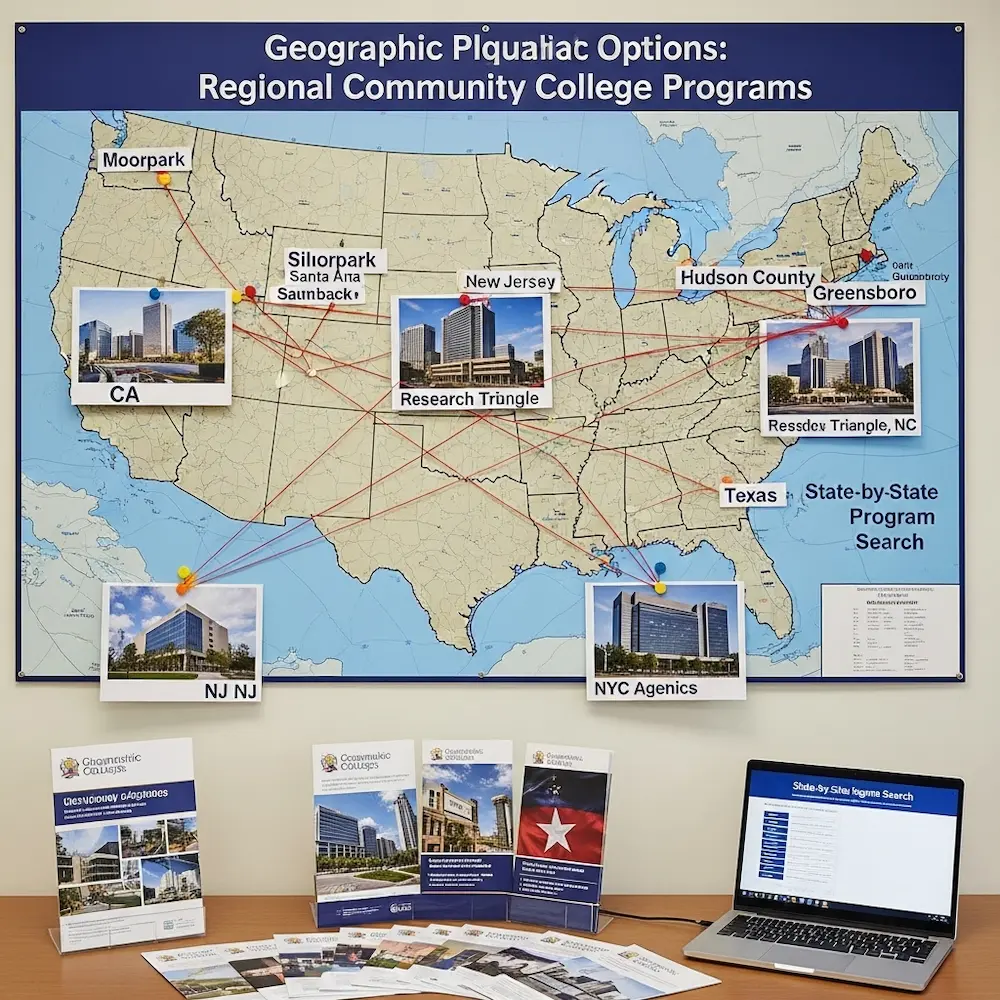
California’s Robust System
Moorpark College in Ventura County offers comprehensive online graphic design certificate. The college’s “Online programs offer students a flexible, convenient way to further their education, earn a degree and/or certificate”. Their graphic design program prepares students for industry work or transfer.
Santa Ana College provides degree options including transfer-specific Program B designed for “students to transfer to a state university”. Their digital media program emphasizes “visual literacy” and “competency in critical analysis”.
Saddleback College and other California community colleges offer online graphic design courses contributing to certificates and degrees. California’s extensive community college system provides abundant options for residents.
East Coast and Midwest Programs
Hudson County Community College in New Jersey offers Digital Art and Design Certificate preparing “students for continued study and professional work in various areas of computer-based art and design including graphic design, web design, digital video and animation”. Students can “apply the credits earned towards the A.F.A. Studio Arts, Computer Art Option at HCCC”.
North Carolina community colleges serve the Research Triangle’s design industry with programs at Greensboro and other locations. Our geographic cluster article exploring online graphic design colleges by state details specific NC options.
Wisconsin Technical Colleges and Iowa community colleges offer online graphic design coursework, though program structures vary by institution.
Southern Regional Programs
South Carolina community colleges provide graphic design training with regional employment connections. Texas community colleges serve major metro markets (Dallas, Houston, Austin) with online graphic design programs. Our state-focused article examines these regional options comprehensively, helping students identify online college for graphic design for texas residents or florida online graphic design colleges.
Should I Take Community College Classes Online for Graphic Design?
This decision depends on individual circumstances, goals, and learning preferences.

When Community College Is the Right Choice
Financial constraints: If college cost is primary concern, community college represents the cheapest online college for graphic design education period. No other legitimate option costs less while providing accredited credentials.
Career exploration: Uncertain if design is right career path? Invest $1,500 in a certificate rather than $40,000 in a bachelor’s degree first year. Test passion and aptitude affordably.
Working professional adding skills: Marketing coordinators, small business owners, or professionals in adjacent fields adding design capabilities benefit from focused certificate programs. Full degrees aren’t necessary when building specific skill sets.
Transfer strategy: Students planning bachelor’s degrees can save $15,000-$40,000 completing first two years at community college then transferring. Identical final degree, dramatically lower cost.
When to Consider Alternatives
Immediate university networking: Students prioritizing campus life, student organizations, and early professional networking may prefer starting at four-year institutions. Community colleges offer education but typically less robust campus culture.
Specialized programs unavailable at community colleges: Advanced specializations (motion graphics, UX design, specific software beyond Adobe Suite) may require university programs from the start. However, foundational skills transfer—learn basics affordably, then specialize.
Financial aid covering university costs: Students with substantial scholarships or financial aid packages making universities affordable should evaluate whether community college savings justify different educational experience. But for most students, community college represents superior financial strategy.
Conclusion
Online graphic design community college programs transform design education from expensive luxury into accessible opportunity. From comprehensive certificate programs like Moorpark College’s 24-unit Certificate of Achievement costing approximately $1,500 for in-state students through associate degrees providing both standalone credentials and strategic transfer pathways to four-year institutions, community colleges deliver legitimate design education at a fraction of traditional costs. My journey from sticker shock at private art school bills to successful community college graduate transferring to complete an affordable bachelor’s degree proved that educational quality isn’t determined by price tag—it’s determined by curriculum rigor, instructor expertise, and student effort. The software training, design principles, and portfolio pieces I created in community college classes matched work from expensive universities, because we all learned the same Adobe tools, studied the same design theory, and solved the same creative challenges.
The practical advantages explored here—costs often under $5,000 for complete certificate programs, clear transfer pathways saving $15,000-$40,000 on bachelor’s degrees, flexible online formats enabling work-while-learning, and legitimate credentials preparing graduates for employment—position community colleges as the cheapest online college for graphic design without sacrificing educational quality. For comprehensive context on how community college programs fit within the broader landscape of online graphic design education, explore our pillar directory of online graphic design colleges comparing all program types. For students planning bachelor’s degree completion, our article on top online colleges for graphic design degrees examines transfer destinations including universities welcoming community college graduates. And for geographic-specific program information, our state-by-state guide covers california college transfer online graphic design pathways, florida online graphic design colleges, options for texas residents, and programs throughout North Carolina, Minnesota, Iowa, Wisconsin, and beyond.


