

Is a Masters in Graphic Design Worth It? Complete ROI Analysis for 2025
Table of Contents
Is a masters in graphic design worth it? This question weighs heavily on designers considering advanced education, especially when facing tuition costs between $40,000 and $137,376 and two to three years of study. The answer isn’t straightforward—while some professionals find graduate degrees essential for career advancement and teaching positions, others thrive without them. This comprehensive guide examines the return on investment, career benefits, financial implications, and practical considerations to help you make an informed decision about pursuing graduate education in graphic design.
This article is part of our comprehensive guide on masters in graphic design, which explores all aspects of graduate design education. Here, we’ll dive deep into whether the investment makes sense for your specific career goals, analyzing salary increases, job opportunities, alternative paths, and real-world perspectives from design professionals. By the end, you’ll have a clear framework for evaluating whether a masters degree aligns with your professional aspirations and financial situation.
The Financial Investment: Understanding True Costs
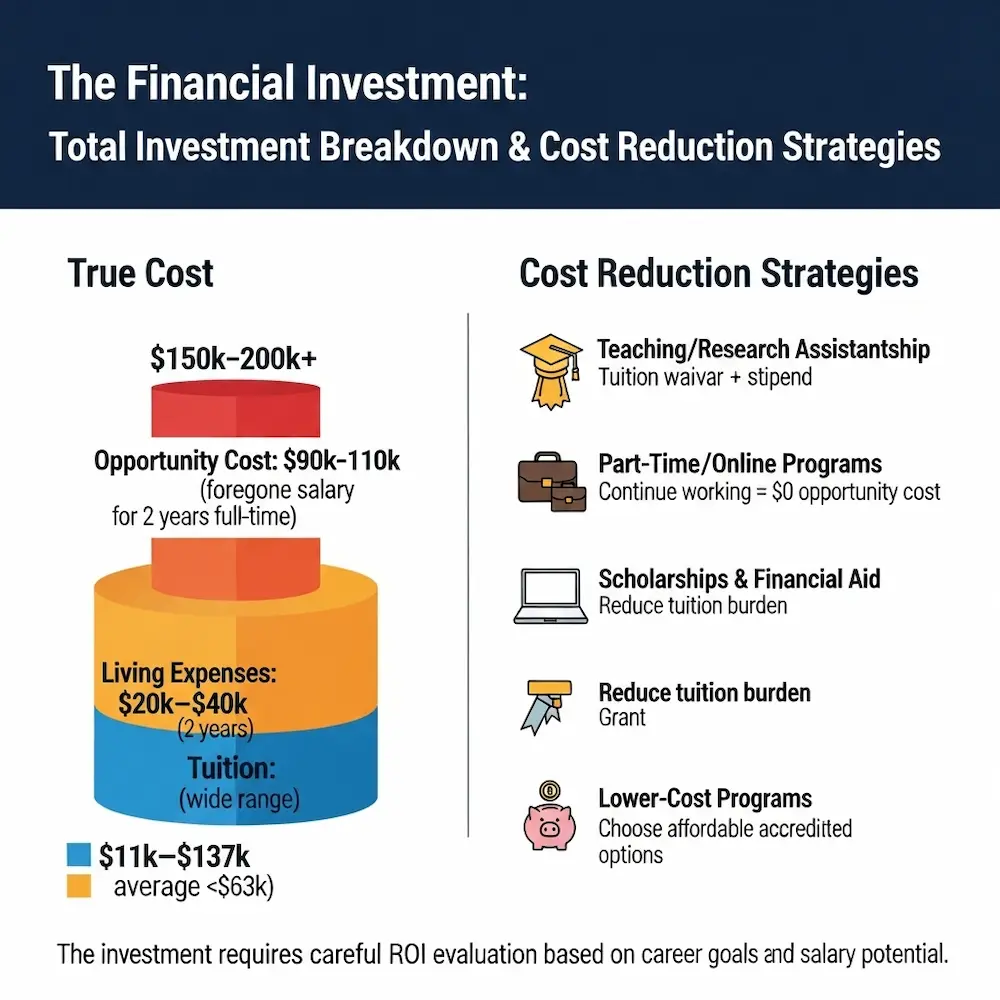
The cost of a masters in graphic design varies dramatically depending on institution, location, and program format. In the United States, tuition ranges from $11,180 at Bentley University to $137,376 at Carnegie Mellon University, with the average program costing approximately $62,700 for the entire degree. UK programs typically cost £40,000–£60,000 ($50,000–$75,000) for the full program, while international students often pay significantly more. These figures represent tuition alone, not including living expenses, materials, software subscriptions, and opportunity costs from leaving the workforce.
Opportunity cost represents the income you forgo by studying full-time instead of working. If you’re currently earning $45,000–$55,000 annually as a graphic designer, a two-year full-time program means sacrificing $90,000–$110,000 in potential earnings. Combined with tuition and living expenses, the total investment can easily exceed $150,000–$200,000. This substantial financial commitment requires careful evaluation of potential returns through salary increases, career advancement, and expanded opportunities.
Some programs offer financial aid, scholarships, assistantships, and part-time options that can reduce costs significantly. Teaching or research assistantships may cover tuition while providing valuable experience and modest stipends. Part-time and online programs allow you to continue working while studying, though they extend the timeline to 3-4 years. For detailed information on flexible learning options that minimize opportunity costs, review our guide on masters in graphic design online.
Salary Benefits and Career Advancement Potential
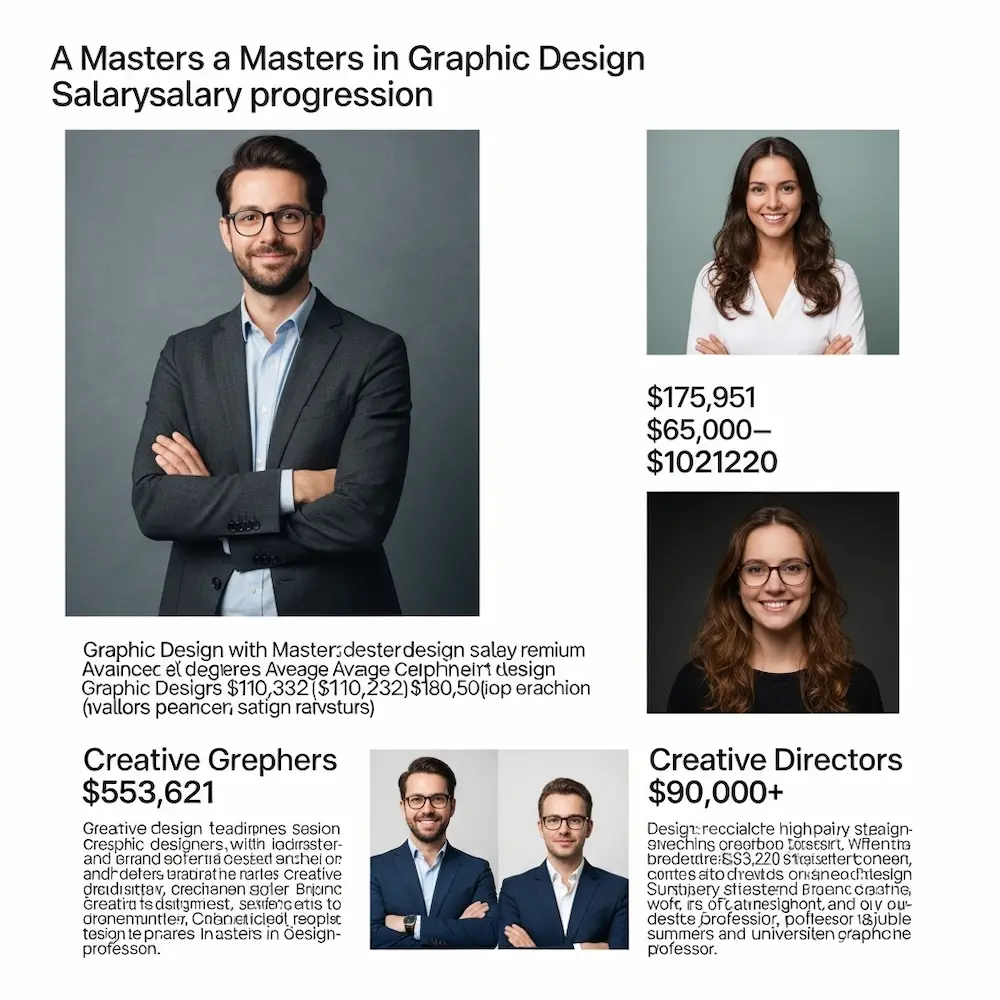
Earning a masters in graphic design salary premium varies significantly based on role, industry, and career trajectory. Graphic design graduates with masters degrees earn an average of $55,951 annually, with top earners reaching $77,500. However, the degree’s true value emerges in advanced positions: graphic design teachers command average salaries of $110,232 (with top earners reaching $180,500), while senior graphic designers earn $65,000–$102,620, and creative directors earn $90,000–$110,000+.
The salary progression demonstrates meaningful financial returns over a career span. A bachelor’s degree holder averages $53,661, while someone with only an associate degree earns $48,143. While the initial salary difference may appear modest, the compounding effect over a 30-40 year career becomes substantial. Graduate degree holders also advance to leadership positions faster, accessing roles in creative direction, brand strategy, and design management that remain largely inaccessible without advanced credentials.
Beyond direct salary increases, a masters degree qualifies you for specialized high-paying roles including digital content strategist ($83,220), design researcher, brand strategist, and university professor. These positions often provide better work-life balance, creative autonomy, and job security compared to junior design roles. Teaching positions, in particular, offer stable income, benefits, summers off, and the satisfaction of mentoring the next generation of designers. To understand what career opportunities become available, explore our comprehensive guide on masters in graphic design.
Career Opportunities: What Opens Up With a Graduate Degree
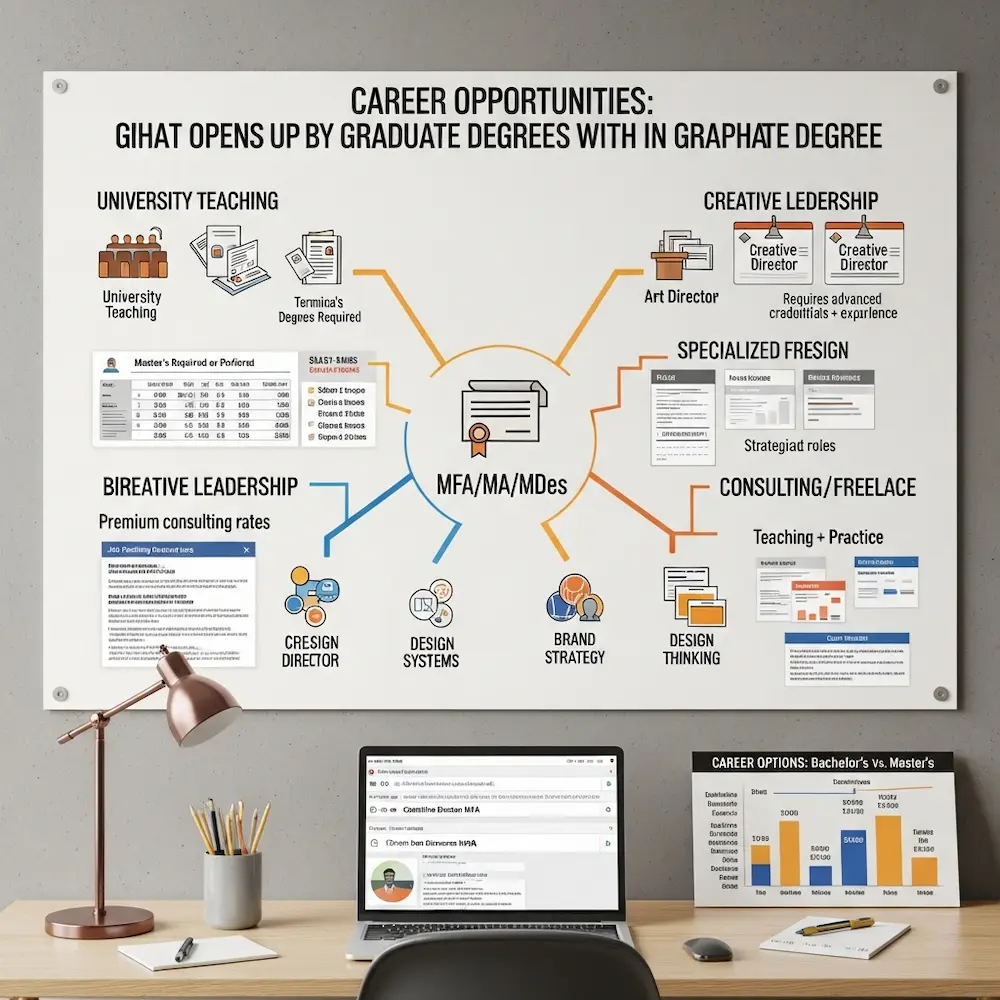
What can I do with a masters in graphic design? The answer extends far beyond traditional graphic design roles. Graduate credentials qualify you for university-level teaching positions, which typically require a terminal degree like an MFA, MDes, or MA. These roles offer salaries averaging $110,232, intellectual engagement, creative freedom, and the opportunity to shape design education. Many design educators balance teaching with professional practice, consulting, or personal creative projects, creating diversified income streams.
Creative leadership positions become significantly more accessible with graduate education. Art director, creative director, and design director roles involve strategic thinking, client relations, team management, and high-level creative decision-making—skills emphasized in graduate programs. These positions typically require 5-10 years of experience plus advanced credentials, offering salaries of $90,000–$150,000+ and substantial influence over brand identity and visual strategy.
Graduate degrees also open doors to specialized design fields including UX research and strategy, design thinking facilitation, brand strategy consulting, design systems leadership, and creative technology roles. These emerging career paths value the theoretical knowledge, research methodologies, and strategic thinking developed in graduate programs. Freelancers with masters degrees can command premium rates ($50–$150 per hour vs. $15–$35 for bachelor’s holders), potentially earning $100,000+ annually with a full client roster. For insights into various program offerings and specializations, visit our article on masters programs in graphic design.
Weighing the Pros and Cons
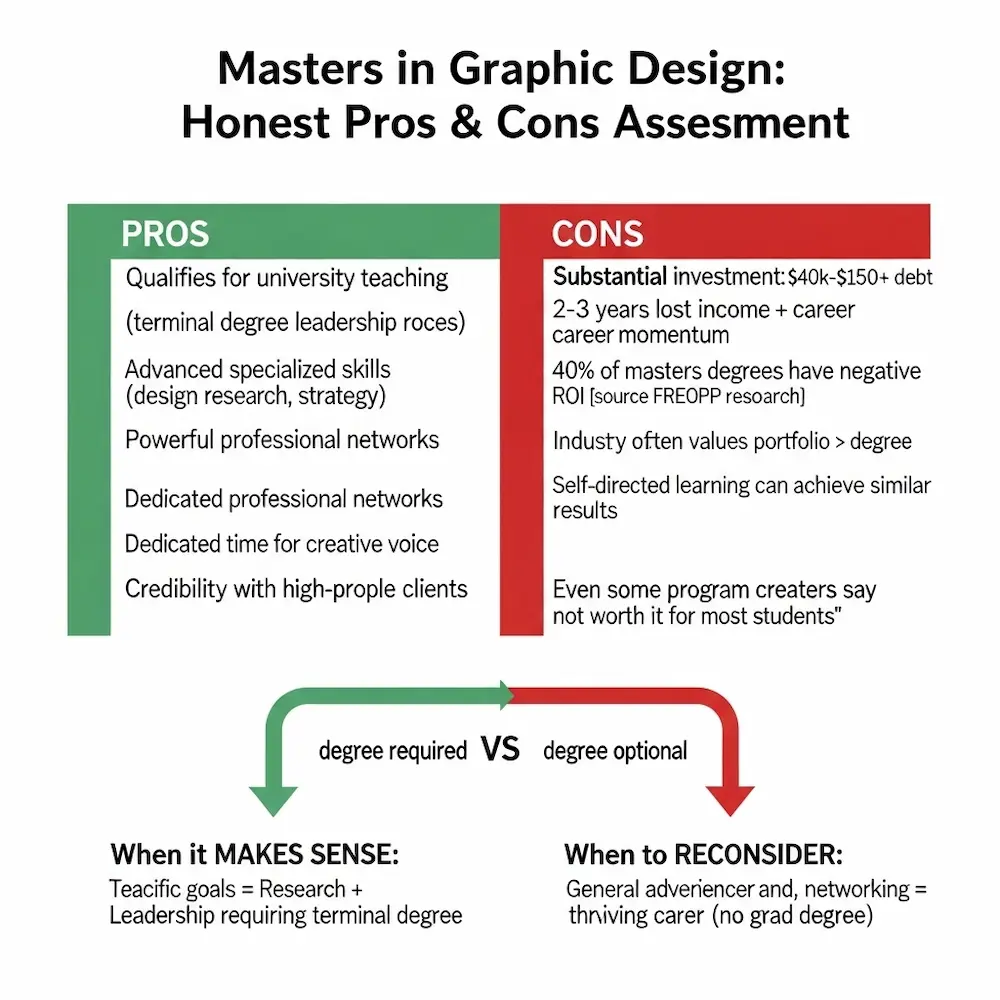
Understanding the benefits of masters degree in graphic design requires honest assessment of both advantages and drawbacks. Pros include: qualification for university teaching positions (often requiring terminal degrees), eligibility for senior leadership roles that prefer or require graduate credentials, development of advanced specialized skills in areas like design research and strategy, access to powerful professional networks through faculty and alumni connections, and credibility boost with high-profile clients and employers. Graduate education also provides dedicated time for creative experimentation, portfolio refinement, and developing your unique design voice without commercial pressures.
The cons are equally significant. Substantial financial investment ($40,000–$150,000+) creates debt that may take decades to repay, while two to three years out of the workforce means lost income and career momentum. Many successful graphic designers build thriving careers without graduate degrees through self-directed learning, online courses, networking, and portfolio development. The design industry often values portfolio quality and practical experience over academic credentials, meaning strong work can outweigh degree prestige.
The risk-reward calculation depends heavily on individual circumstances. Research shows that 40% of masters degrees have negative ROI, meaning graduates never recoup their educational investment through increased earnings. One design professor who created a masters program admitted “it wasn’t worth it” for most students, suggesting alternatives like an MBA provide better career versatility. The degree makes most sense when you have specific goals requiring advanced credentials—teaching, leadership roles, specialized research—rather than general career advancement hopes. For a broader understanding of when graduate education makes strategic sense, review our complete guide on masters in graphic design.
Who Should (and Shouldn’t) Pursue a Masters
A masters in graphic design makes strategic sense if you: want to teach design at the college or university level (terminal degree required), aim for creative director or senior leadership positions requiring advanced credentials, seek deep specialization in design research, branding strategy, or emerging fields, thrive in academic environments with structured learning and peer critique, have financial resources or funding that minimizes debt burden, or need career pivoting into design from another field and want intensive training. Academic careers particularly reward graduate education, with teaching positions requiring MFA or equivalent terminal degrees and offering stable salaries averaging $110,232.
You likely don’t need a masters if you: are early in your career without clear direction (gain experience first), have substantial student debt from undergraduate education, learn best through hands-on practice rather than theory, want to immediately enter or continue working in the industry, are building successful freelance practice or agency work, or seek general skill improvement rather than specialized expertise. Many thriving designers succeed through self-directed learning, online courses, bootcamps, mentorship, and portfolio development at a fraction of graduate school costs.
The ideal candidate often has 3-5 years of professional experience, clear career goals requiring advanced credentials, financial stability or funding support, and genuine passion for design theory, research, and pedagogy. Working professionals can pursue part-time or online programs while maintaining employment, reducing opportunity costs significantly. For detailed information on flexible program options that allow you to work while studying, explore our guide on masters in graphic design online.
Alternative Paths to Career Advancement
Before committing to graduate school, consider alternatives that offer substantial professional development at lower cost and time investment. Online learning platforms like Coursera, LinkedIn Learning, Skillshare, and Domestika offer specialized courses in typography, branding, UX design, and motion graphics for $20–$50 monthly or $200–$1,000 per comprehensive program. Many successful designers build expertise through curated self-study, spending $1,000–$3,000 on courses versus $40,000–$150,000 for graduate degrees.
Professional certifications and bootcamps provide intensive training in 3-12 months at $3,000–$15,000. Programs like Certified Web Professional (CWP) or Certified Digital Designer (CDD) add marketable credentials without graduate school time commitment. Design bootcamps offer immersive learning with career services, portfolio development, and industry connections comparable to graduate programs at a fraction of the cost.
Strategic experience-building through freelancing, agency work, side projects, and mentorship often delivers equivalent or superior results. Invest in attending design conferences ($500–$2,000 annually), joining professional organizations like AIGA, building a standout portfolio, networking strategically, and seeking mentorship from experienced designers. This approach allows you to earn while learning, avoid debt, and build relevant experience that many employers value more than academic credentials. An MBA may offer better ROI than an MFA for those seeking business leadership roles, management positions, or entrepreneurial ventures, providing broader career versatility.
Making Your Decision: A Practical Framework
To determine if pursuing a masters degree makes sense for your situation, evaluate these critical factors systematically. Calculate your financial break-even point: add total costs (tuition + living expenses + lost income) and divide by expected annual salary increase. If you invest $120,000 total and expect a $15,000 annual salary boost, you’ll break even in 8 years—meaning the degree pays off if you work 10+ years post-graduation. Factor in loan interest, which can extend payback timelines significantly.
Assess your career goals specificity. Graduate school makes sense when you have clear objectives requiring advanced credentials: university teaching, creative direction at major agencies, specialized roles in design research or strategy, or pivoting from another field into design leadership. Vague goals like “becoming a better designer” or “learning new skills” are better addressed through targeted online learning, mentorship, and professional experience.
Consider your learning style and life circumstances. Do you thrive in academic settings with structure, deadlines, and peer critique, or do you learn best through independent practice and real-world projects? Can you commit to 2-3 years of intensive study, or do family and financial obligations make part-time or online learning more practical? Evaluate program quality by examining faculty credentials, alumni outcomes, curriculum relevance, industry connections, and student work quality. Visit our comprehensive resource on masters programs in graphic design to compare program offerings and outcomes.
Conclusion
So, is a masters in graphic design worth it? The answer depends entirely on your career goals, financial situation, learning style, and specific circumstances. For designers pursuing university teaching careers, specialized research roles, or senior creative leadership positions, a graduate degree offers clear pathways and credibility that justify the investment. The salary premium in advanced roles—particularly teaching positions averaging $110,232—can deliver positive ROI over a career span.
However, for many designers, alternative paths through online learning, professional certifications, strategic experience-building, and portfolio development offer comparable or superior outcomes at fraction of the cost and time. The design industry rewards talent, portfolio quality, and practical skills more than credentials in most contexts. With program costs reaching $40,000–$137,376 and 40% of masters degrees showing negative ROI, careful evaluation is essential.
Use the framework provided in this guide to calculate your break-even point, assess career goal specificity, and evaluate alternatives systematically. If you decide to pursue graduate education, prioritize programs with strong faculty, relevant specializations, funding opportunities, and proven alumni outcomes. For comprehensive information on program options, requirements, and career pathways, revisit our main guide on masters in graphic design. Additionally, explore our resources on masters in graphic design online for flexible learning options and masters programs in graphic design to compare specific offerings. Make your decision based on data, clear goals, and honest self-assessment rather than assumptions about credentials guaranteeing success.
FAQ
Is a masters in graphic design worth it in 2025?
A masters in graphic design is worth it if you have specific career goals like university teaching, creative direction, or specialized research that require advanced credentials. The degree delivers positive ROI when salary increases justify costs—typically within 8-10 years for teaching positions averaging $110,232. However, 40% of masters degrees show negative ROI, so evaluate your financial situation, career trajectory, and alternatives before committing to $40,000-$150,000+ investment.
How much does a masters in graphic design actually cost?
Total investment for a masters in graphic design reaches $150,000-$200,000 when combining tuition ($40,000-$137,376), living expenses, and opportunity costs from leaving the workforce. US programs average $62,700 for tuition alone, ranging from $11,180 at Bentley University to $137,376 at Carnegie Mellon. UK programs cost £40,000-£60,000 ($50,000-$75,000), while a two-year full-time program means sacrificing $90,000-$110,000 in potential earnings.
What salary increase can I expect with a masters in graphic design?
Masters degree holders earn $55,951 average salary initially, but significant increases come in specialized roles. Graphic design teachers earn $110,232 average ($180,500 top earners), senior graphic designers earn $65,000-$102,620, creative directors earn $90,000-$110,000+, and digital content strategists earn $83,220. Bachelor’s holders average $53,661, showing a modest initial difference that compounds over 30-40 year careers.
How long does it take to break even on a masters in graphic design?
Calculate break-even by dividing total costs by expected annual salary increase. If you invest $120,000 total and expect a $15,000 annual salary boost, you’ll break even in 8 years—meaning the degree pays off if you work 10+ years post-graduation. Factor in loan interest which extends payback timelines, and remember 40% of masters degrees never achieve positive ROI.
What jobs can I get with a masters in graphic design?
A masters qualifies you for university teaching positions ($110,232 average), creative director roles ($90,000-$150,000+), UX research and strategy, design thinking facilitation, brand strategy consulting, and design systems leadership. Many design educators balance teaching with consulting or personal projects for diversified income. Freelancers with graduate degrees command $50-$150 per hour versus $15-$35 for bachelor’s holders, potentially earning $100,000+ annually.
Should I get work experience before pursuing a masters degree?
Yes, ideal candidates typically have 3-5 years of professional experience, clear career goals requiring advanced credentials, and genuine passion for design theory and research. Early-career designers without clear direction should gain practical experience first rather than immediately pursuing graduate school. Work experience helps you maximize graduate education value, clarify specialization interests, and make informed decisions about ROI.
Can I work full-time while getting a masters in graphic design?
Yes, part-time and online masters programs allow you to continue working while studying, extending the timeline to 3-4 years but reducing opportunity costs significantly. Teaching or research assistantships in full-time programs may cover tuition while providing modest stipends and valuable experience. Working professionals should explore flexible program options that maintain employment and income during studies.
What are cheaper alternatives to a masters in graphic design?
Online learning platforms (Coursera, LinkedIn Learning, Skillshare, Domestika) offer specialized courses for $20-$50 monthly or $200-$1,000 per comprehensive program. Professional certifications and bootcamps provide intensive training in 3-12 months at $3,000-$15,000. Strategic freelancing, agency work, design conferences ($500-$2,000 annually), AIGA membership, and mentorship programs cost $1,000-$15,000 total versus $40,000-$150,000 for graduate degrees.
When does a masters in graphic design NOT make sense?
Skip a masters if you’re early in your career without clear direction, have substantial undergraduate debt, learn best through hands-on practice, want to immediately enter the industry, are building successful freelance or agency work, or seek general skill improvement. Many thriving designers succeed through self-directed learning, online courses, mentorship, and portfolio development at fraction of graduate school costs. The design industry often values portfolio quality and practical experience over academic credentials.
Is an MBA or MFA better for graphic designers?
An MBA offers better ROI for business leadership roles, management positions, or entrepreneurial ventures, providing broader career versatility beyond design. An MFA is essential for university teaching (terminal degree required) and emphasizes creative practice, portfolio development, and artistic voice. Choose based on career goals: MFA for creative leadership and teaching, MBA for business management and entrepreneurship.
What are the biggest pros and cons of getting a masters in graphic design?
Pros: qualification for university teaching ($110,232 average), eligibility for senior leadership roles, development of specialized skills, powerful professional networks, credibility with high-profile clients, and dedicated time for portfolio refinement. Cons: $40,000-$150,000+ debt taking decades to repay, 2-3 years of lost income and career momentum, and the fact that many designers succeed without graduate degrees through portfolio quality and practical experience.
How do I calculate if a masters degree is worth it for my situation?
Systematically evaluate: (1) financial break-even point by dividing total costs by expected salary increase, (2) career goal specificity—degree makes sense for teaching, creative direction at major agencies, or specialized research, (3) learning style preference for academic versus hands-on environments, and (4) program quality through faculty credentials, alumni outcomes, and industry connections. Vague goals like “becoming a better designer” are better addressed through online learning, mentorship, and professional experience.